

Chile & Argentina Ultimate Patagonia Hiking Tour
A Bucket-List Hiking Adventure in Torres del Paine & Los Glaciares
- Available: January, February, March, November, December
- Activity: Level 4
- Accommodations: Comfortable Hotels, Rustic Lodging
Highlights
- Trek the iconic "W" route in Chile's Torres del Paine National Park
- Take in spectacular vistas of Cerro Torre and Fitz Roy in Argentina's Los Glaciares National Park
- Be awestruck by sweeping views of the Perito Moreno Glacier with its 240-foot high wall of calving ice
Itinerary
Arrive in Puerto Natales or Punta Arenas
Day 1
Arrive at the airport in Punta Arenas or Puerto Natales, a quiet fishing town on the shores of Seno Ultima Esperanza (Last Hope Sound), and transfer to the hotel. In the early evening, gather with the group for a briefing on the adventure ahead, followed by a welcome dinner.
Accommodation: Hotel Costaustralis
Accommodation: Remota Patagonia LodgeTransportation: 20-minute private van transfer from Puerto Natales or 3-hour private van transfer from Punta Arenas
Meals: Dinner
Scenic Drive to Torres del Paine National Park
Day 2
After breakfast, travel across the Patagonian plains to Torres del Paine National Park and take in your first spectacular views of the Paine Massif (weather permitting). There is also a very good chance of seeing guanacos - small cousins to the camel and llama - on the way to the park. Arrive this afternoon at your hotel on the western side of the park. Head out on a scenic hike from Laguna Verde to Rio Paine, winding through forests of lenga and coigue—a gentle introduction to Patagonia’s terrain and native flora with impressive views of Paine Grande.
Accommodation: Hotel Lago Grey
Activity: 4-5 hours/8 miles hiking with 1,000' elevation gain & 1,000' loss
Transportation: 2-hour private van transfer
Meals: Breakfast, Lunch, Dinner
Take a Boat to Grey Glacier & Begin W-Route Trek
Day 3
Arise early and board a catamaran that takes you close to the front of the stunning Grey Glacier, at the southern end of the Southern Patagonia Ice Field. Disembark at the nearby trailhead and begin the classic "W" route trek, heading away from the glacier and along Grey Lake and the Paine Grande Mountain. Overnight at a remote mountain refuge on the shore of Lake Pehoe, with simple dormitory-style rooms and beautiful views - an excellent staging area for tomorrow's hike into the French Valley.
Accommodation: Refugio Paine Grande
Activity: 4 hours/7.5 miles hiking with 1200' elevation gain & 1200' elevation loss
Transportation: 45-minute catamaran cruise
Meals: Breakfast, Lunch, Dinner
Hike into the French Valley
Day 4
Begin your trek deep into the park, continuing to circle beneath Paine Grande Mountain to the entrance of the French Valley, one of the most spectacular cirques in the Paine Range and the middle leg of the "W" route. You'll gain elevation as you hike into the valley, walking below the glaciers that descend from the massif's highest summit and marveling at the gray granite peaks of the Cuernos del Paine, topped with fantastical black slate "horns." After reaching the French Valley lookout with its awe-inspiring views, head to your cabins beneath the jagged Cuernos ("horns") del Paine. Stay in cozy cabins right next to a waterfall on the most isolated spot of the journey, with a prime position to view sunset hitting the horns, followed by dark night skies filled with stars.
Accommodation: Cabanas de los Cuernos
Activity: 8-9 hours/12 miles hiking with up to 2,800' elevation gain & 2,800' elevation loss
Meals: Breakfast, Lunch, Dinner
Hike below Cuernos del Paine
Day 5
Hike at a relaxed pace along gently rolling terrain from Los Cuernos, taking the Paso Los Cuernos trail as it follows the north shore of Lago Nordenskjold. The views are magnificent - from forested paths to the gravel lakeshore, and occasional glimpses of the horns of the Paine massif, weather permitting.
Accommodation: Hotel Las Torres-Torres del Paine National Park
Activity: 5 hours/8 miles hiking with 1,400' elevation gain & 1,400' elevation loss
Meals: Breakfast, Lunch, Dinner
Hike to the Base of the Majestic Torres del Paine
Day 6
Get an early start for an all-day hike to the base of the Torres del Paine. Follow the Asencio River over a low pass into the Asencio Valley, passing through beautiful beech forests and talus-covered slopes. After a final steep climb up a boulder field, arrive at a spectacular viewpoint that is one of the most scenic spots in the world, where the towers rise majestically before you and a glacial lake is visible below. Enjoy a packed lunch en route before returning to the hotel.
Accommodation: Hotel Las Torres-Torres del Paine National Park
Activity: 9 hours/11.5 miles hiking with 3,400' elevation gain & 3,400' elevation loss
Meals: Breakfast, Lunch, Dinner
Travel to Argentina & Explore El Calafate
Day 7
Depart Chile's Torres del Paine National Park and drive across the border into Argentina. (Please be prepared for delays of up to a few hours while crossing the border). Proceed over the flat grassland steppes to the town of El Calafate, located on the southern shore of an enormous glacial lake called Lago Argentino, and considered the gateway to Perito Moreno Glacier.
Accommodation: Hotel Posada Los Alamos-El Calafate
Transportation: 7-hour private van transfer
Meals: Breakfast, Lunch
Marvel at the Perito Moreno Glacier & Drive to El Chalten
Day 8
Enjoy a morning trip to the renowned Perito Moreno glacier. At this very active glacier, a 200-foot-high headwall continually calves massive blocks of ice into the lake with a thunderous roar - an awesome spectacle of nature's power at work. Admire the amazing glacier from different viewpoints on a 2-mile guided footbridge walk. Enjoy lunch at a restaurant overlooking the glacier before an afternoon drive across the steppes and along the northern end of Lago Viedma, with the views getting better and better as you approach the mountains and glaciers of the Fitzroy and Cerro Torre ranges in Los Glaciares National Park.
Accommodation: Destino Sur Hotel de Montana & Spa
Accommodation: Patagonia Eco DomesActivity: 2 hours/2 miles walking with 350' elevation gain & 350' elevation loss
Transportation: 7-hour private van transfer
Meals: Breakfast, Lunch, Dinner
Hike along the Rio Electrico to Piedra del Fraile and Lago Electrico
Day 9
From the trailhead at Rio Electrico Bridge, hike along the Rio Electrico Valley, which progresses gently uphill from west to east, and pass through a beautiful lenga forest to reach Piedra del Fraile, one of the first refuges in the area, protected from the winds and offering comfort to the world's most experienced climbers and mountaineers, as well as to trekkers arriving in the area for the first time. This less travelled path boasts impressive views of the north face of Fitz Roy and solitude, and the lenga forest is alive with the sounds of native birds. Wind conditions permitting, emerge back into open terrain and cross the boulder field of a glacial valley to reach the shores of Lago Electrico, fed by the Marconi Glacier.
Accommodation: Destino Sur Hotel de Montana & Spa
Accommodation: Patagonia Eco DomesActivity: 6-7 hours/11 miles hiking with 1,150' elevation gain & 1,150' elevation loss
Meals: Breakfast, Lunch, Dinner
Trek to Laguna de Los Tres
Day 10
Another day, another inspiring day hike into Los Glaciares. A short transfer brings you back to the trail head at Rio Electrico Bridge, before setting out on an easy walk through a beautiful forest with impressive views of Piedras Blancas Glacier as well as the Fitz Roy, Saint Exupery, and Poincenot Peaks. After passing Poincenot Camp, begin a steep climb up to Laguna de los Tres — a challenging effort, but worthwhile for its superb views of Fitz Roy and its hanging glaciers. At the top take in the beautiful surroundings before hiking back to El Chalten via the secluded and very scenic Laguna Capri.
Accommodation: Destino Sur Hotel de Montana & Spa
Activity: 8-9 hours/13.5 miles hiking with 3,150' elevation gain & 3,150' elevation loss
Meals: Breakfast, Lunch, Dinner
Follow Trails to Laguna Torre
Day 11
Embark on a long day hike into the park's interior. Walk through a varied landscape formed by glaciers and stop for commanding views of the south face of Cerro Torre — sought after by photographers and climbers the world over. Reach the pinnacle of your trek at Laguna Torre, a beautiful glacial lake set against the backdrop of Cerro Torre, with its iconic pointy spires and hanging glaciers.
Accommodation: Destino Sur Hotel de Montana & Spa
Activity: 7-8 hours/11 miles hiking with 1,800' elevation gain & 1,800' elevation loss
Meals: Breakfast, Lunch, Dinner
Transfer to El Calafate and Depart
Day 12
Transfer back to El Calafate this morning, arriving in time for early afternoon flight departures to extend your adventure on your own or with one of our extensions in Argentina, or to begin your journey home.
Transportation: 3-hour private van transfer
Meals: Breakfast
Why Travel With Us?
MT Sobek pioneered commercial trekking in Patagonia in the 1970s, and this 12-day itinerary is perfectly paced and the most comprehensive route available.
Stay in comfortable hotels, cozy cabins, and remote mountain lodges - all ideally located to enjoy spectacular hiking opportunities without needing to camp!
Our highly experienced MT Sobek leaders know every inch of this region and ensure the logistics of this multi-faceted trip run seamlessly.
Dates & Prices
Price is per person, double occupancy in USD.
The earlier you book, the more choice of available dates you’ll have and once you book, your price is guaranteed.
Your Guides
The best people to immerse you in a destination are the ones who live there, which is why we feature local Adventure Guides on our trips. Here are a few that you might meet on this adventure.

Andre L.
André is an accomplished mountaineer who has dedicated over 25 years to climbing and exploring the Peruvian and Patagonian Andes ranges. He grew up in central Chile and fell in love with Patagonia at first sight and made it his home for 20 years before recently moving to Chile's Araucania region. In over ten mountain expeditions in Patagonia, he accomplished many first ascents, and has climbed the Paine towers in Chile and Alpamayo in Peru. A very enthusiastic guide, André’s love for nature and respect for the mountains is infectious to all who travel with him.

Rodrigo B.
“Ro” was born in the Last Hope Province of Chile and grew up in Patagonia, where he developed a deep love for the outdoors. He has guided in Patagonia and Canada for more than 15 years, and is an accomplished hiker, kayaker, mountaineer, and photographer—with a keen eye for capturing the natural beauty of Patagonia. He is a certified Mountain guide and kayak instructor and has completed Wilderness Emergency Responder & Medical; (WFR NOLS-EASPA). Ro speaks English, Spanish, and conversational French.

Cristian S.
Cristian was born and raised in Punta Arenas Patagonia, Chile. With such spectacular wilderness in his backyard, it's no wonder he quickly developed a curiosity for the beautiful natural world that surrounded him. His passion led to his career, and he now has more than 25 years of outdoor leadership under his belt. Christian guides numerous activities, including horseback riding, trekking, and kayaking. He loves sharing his backyard with others, and we're confident that you'll be captivated by his stories. From local flora and fauna to Chilean history and culture, Cristian is extremely knowledgeable about this region of the world. Cristian currently lives in Santiago, Chile where you can find him when he isn't out exploring.
Activity Level
This trip is rated activity level 4. Long hikes with support of porters in Torres del Paine and day hiking in El Chaltén. You will be hiking between 5 to 10 hours a day, mostly on steep and rocky terrain. The back-to-back days and challenging terrain can be taxing. Strong winds are common and weather can change drastically, causing temperatures to fluctuate rapidly. These conditions can affect both body and morale.
Learn more about activity levels here.
Activity Snapshot
Day 2
4-5 hours/8 miles hiking with 1,000' elevation gain & 1,000' loss
Day 3
4 hours/7.5 miles hiking with 1200' elevation gain & 1200' elevation loss
Day 4
8-9 hours/12 miles hiking with up to 2,800' elevation gain & 2,800' elevation loss
Day 5
5 hours/8 miles hiking with 1,400' elevation gain & 1,400' elevation loss
Day 6
9 hours/11.5 miles hiking with 3,400' elevation gain & 3,400' elevation loss
Day 8
2 hours/2 miles walking with 350' elevation gain & 350' elevation loss
Day 9
6-7 hours/11 miles hiking with 1,150' elevation gain & 1,150' elevation loss
Day 10
8-9 hours/13.5 miles hiking with 3,150' elevation gain & 3,150' elevation loss
Day 11
7-8 hours/11 miles hiking with 1,800' elevation gain & 1,800' elevation loss
*Mileage and elevation change information is approximate and may vary slightly depending on trail conditions, weather, and route adjustments, and the guide’s discretion.
Accommodations
A range of lodging, from scenic mountain cabins and one dormitory to comfortable hotels with modern amenities.
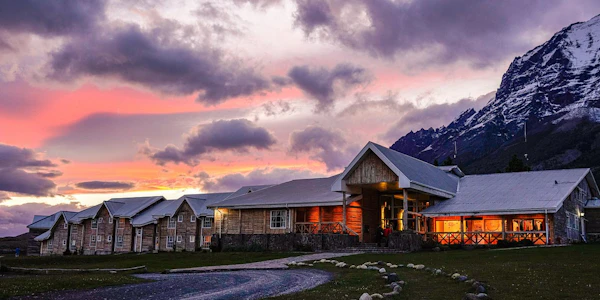
Hotel Las Torres-Torres del Paine National Park
The simple, comfortable rooms come equipped with all the essentials, and have windows showcasing the awe-inspiring surroundings. Because of its remote location, the hotel has a small shop that provides some trekking equipment, snacks and toiletries. The on-site restaurant serves food that is authentic to the Patagonia region, featuring organic produce and beer from their own microbrewery.

Cabanas de los Cuernos
These eight charming cabins, located at the base of the "horns" (Cuernos del Paine) at the heart of the W Route, offer spectacular views of Los Cuernos - especially at sunset, when the sun hits the horns. After trekking through Torres del Paine, you'll undoubtedly be ready to recharge your battery with a warm meal and a good night's sleep in a real bed, while all others nearby have to camp to enjoy this privileged location.

Refugio Paine Grande
Located on the banks of Pehoe Lake, this remote mountain lodge is an ideal launch point for hiking trails to Torres del Paine's French Valley and Grey Glacier. The dormitory rooms have comfortable bunks, as well as drawers to put away gear and a safety box if required. The on-site restaurant offers American cuisine, and the bar is a great place to exchange stories with fellow travelers.

Hotel Lago Grey
Hotel Lago Grey is the perfect base for discovering the western side of Torres del Paine National Park, and features a privileged view of Grey Lake. The hotel has 60 spacious rooms, including 36 Superior rooms that have lake, mountain, and glacier views. All rooms are warm and comfortable, with Wi-Fi (in common areas), safe, and a phone.

Hotel Posada Los Alamos-El Calafate
Posada Los Alamos is a grand red-bricked hotel, surrounded by soaring poplar trees, in the heart of El Calafate. It's 144 comfortable rooms, with either garden or mountain views, are pleasantly furnished and come with modern amenities. Choose to unwind with a game of golf or a treatment at the hotel's Humus Spa, and enjoy dinner at La Posta restaurant.

Destino Sur Hotel de Montana & Spa
Located just steps from the main street of town yet close to trailheads, Destino Sur offers both convenience and an escape to nature. Each room is colorfully decorated and equipped with wooden furniture, a king-size bed, and lots of amenities. Indulge in a spa massage, or relax in the sauna or Jacuzzi.

Hotel Costaustralis
This lovely hotel is located in the heart of Puerto Natales, with big windows looking out onto the Last Hope Sound and Patagonian mountains, and just steps away from the restaurants and shops of this charming small town. There are 110 rooms, all spacious and modern, with either sea or city views. In-room amenities include complimentary Wi-Fi, cable TV, individually controlled heating, and en-suite bathrooms. The hotel prides itself on providing everything you need for a restful night and its staff are welcoming and helpful.

Remota Patagonia Lodge
Remota Patagonia Lodge is located on the Last Hope Sound, just a short walk from the charming town of Puerto Natales in southern Chile. Designed by award-winning architect German del Sol, the innovative structure was inspired by the old Patagonian shearing sheds tilted by the wind and prioritizes spectacular views throughout. The comfortable, modern guest rooms all feature views of the mountains, the sound, and the glaciers and are decorated with local wood accents and the finest Peruvian textiles. The hotel also features a heated pool, sauna, souvenir shop, bar, and an onsite restaurant featuring local seafood, exotic meats, local organic vegetables, and Chilean wines.

Patagonia Eco Domes
Sitting right on the trailhead to the Fitz Roy Valley and Laguna de Los Tres, Patagonia Eco Domes are tucked into the landscape. Each of the 9 private domes looks out on Fitz Roy and is equipped with a private bath, wood burning stove, and solar power. A larger dome, also with an outstanding view, holds the restaurant, lounge, and reception. Enjoy a stay away from the crowds, surrounded by lush Patagonian scenery.
Weather
Expect extreme weather conditions that can change from one moment to the next. Be prepared for everything, especially strong winds and sun.
FAQs
Trip Overview
Pioneering Patagonia since the 1970s, MT Sobek delivers the region’s most comprehensive hiking experience. This tour seamlessly connects Chile’s Torres del Paine W Trek with Argentina’s Cerro Torre and Fitz Roy. Guided by certified mountain experts, you’ll access iconic granite peaks and glacial lakes while retreating to premier wilderness lodgings rather than campsites.
Longstanding Patagonia Legacy: Travel with the original architects of Patagonia trekking who helped define the region’s commercial routes nearly 50 years ago.
Best of Both Worlds: Experience a continuous, logistics-heavy itinerary that combines the best of Chile’s Torres del Paine and Argentina’s Los Glaciares in one trip.
Porter-Supported Trekking: Enjoy the rigor of the 40-mile W Trek with only a daypack. Our porters handle the heavy lifting between refugios (mountain lodging).
Wilderness Access Without Camping: Stay in highly sought-after, strategically located wilderness lodges and eco-domes that provide trailhead access usually reserved for campers.
Elite Guide Standards: Every departure is led by veteran professional guides with 10+ years of experience and triple-certified (Wilderness First Responder, Sernatur, and CONAF) with specialized training in glaciology and geology.
This itinerary runs from November through April, Patagonia's prime season for trekking. MT Sobek carefully plans each season to ensure hikers can experience Patagonia across a range of ideal seasons, from spring wildflowers to the vibrant foliage of autumn.
Spring Season (November to Early December): Hike among abundant wildflowers with maximum daylight hours and fewer travelers—ideal for those seeking a trail experience with fewer other visitors compared to peak season.
Peak Summer Trekking (Late December to February): Benefit from the season's warmest temperatures and longest daylight hours, as well as the lively atmosphere in gateway towns like El Chalten and Puerto Natales.
Autumn Foliage (March to April): Witness the dramatic shift to fall colors starting in mid-March as peak season crowds begin to disperse—this time of year is particularly beloved by photographers.
The standard minimum age for this trip is 18. This itinerary is designed with adult travelers in mind, based on daily activity levels, accommodations, and overall group experience. Families or groups with children as young as 16 please check out our private departures .
This adventure is designed for experienced hikers, featuring consecutive days of 5 to 10 hours on the trail. You will navigate steep, undulating terrain with significant elevation shifts up to 3,400 feet, all while facing Patagonia’s notoriously rapid weather changes and high-velocity winds that demand physical endurance and mental resilience.
Sustained Endurance: Prepare for high-mileage days on rocky, root-choked trails and challenging boulder fields that test your balance and stamina.
Significant Vertical Change: Tackle rigorous alternating ascents and descents with elevation gains and losses reaching 3,400 feet on the most challenging days.
Low-Altitude, High-Intensity: While you won’t be trekking at altitude, the rugged terrain of Patagonia’s Torres del Paine, Fitz Roy and Cerro Torre ranges requires strong physical conditioning.
Challenging and Varied Terrain: Trails range from forested paths to exposed glacial moraines and loose scree, so sturdy footwear and sure footing are essential.
Mountain Weather: Be ready to hike through sudden rain or the region's famous gale-force winds, which can significantly increase the physical effort of each mile.
Arriving and Departing
If possible, you should fly into Puerto Natales-Teniente Julio Gallardo Airport (PNT) on Day 1. If flights into Puerto Natales are limited for your travel date, Punta Arenas-Presidente Carlos Ibanz Airport (PUQ) is a practical alternative, with a longer transfer.
Note that PNT is expected to be closed intermittently from January through March 2027, for runway works. From January 1 through February 2, commercial flights are expected to operate as usual Fridays, Saturdays, and Sundays, and at least one runway is expected to be open on other days of the week. From February 3 through March 31, PNT commercial flights are expected to operate only on Saturday and Sundays (plus Friday Feb 5, Friday Feb 12, and Friday Mar 26); on other weekdays the PNT airport is expected to be closed. Even though it's a longer drive time to start at Punta Arenas airport instead of Puerto Natales, the drive is incredibly scenic, and travelers enjoy the many photo opportunities and frequent wildlife sightings along the route.
You will depart from El Calafate-Comandante Armando Tola Airport (FTE) at the end of the tour.
Once your reservation with MT Sobek is finalized, we will notify you of your trip's status. After your departure is confirmed to operate, flights and travel arrangements may be purchased. While we can often confirm departures in advance, some decisions may be finalized closer to final payment. We strongly advise checking directly with your Adventure Coordinator before purchasing any non-refundable air arrangements. For expert assistance with your flight plans, we recommend reaching out to Exito Travel at 800-655-4053 or via email at mtsobek@exitotravel.com.
Once your booking is finalized with MT Sobek and your trip has been confirmed to operate, flights may be purchased. If you are unsure of the status of your trip, be sure to check with your Adventure Coordinator prior to booking non-refundable flights.
Arrival: Plan to arrive at Puerto Natales-Teniente Julio Gallardo Airport (PNT) by 4:30 pm on Day 1 of the itinerary. After claiming your luggage, you will meet your MT Sobek representative outside the baggage claim area for a transfer to your hotel in Puerto Natales. Individual and small-group transfers are provided for arrivals into Puerto Natales on Day 1. If you arrive before Day 1, you can take a taxi to your hotel (approximately a 20-minute ride), or we can arrange a private transfer for an additional cost.
If you're unable to find a suitable flight to Puerto Natales, please plan to arrive at Punta Arenas-Presidente Carlos Ibanez Airport (PUQ) at 1:30 pm or earlier on Day 1. We will provide one complimentary group transfer from Punta Arenas to the hotel in Puerto Natales (approximately a 3-hour drive). Your Final Details will include additional information on arrival transfers and orientation.
Departure: You may depart from El Calafate-Comandante Armando Tola Airport (FTE) at 1:30 pm or later on Day 12. A 3-hour private van transfer is provided from the group hotel in El Chalten to the El Calafate airport, timed to coincide with flights departing 1:30 pm or later. If you would like assistance arranging private transfers after the tour concludes at the El Calafate airport, please contact your Adventure Coordinator.
Important note about Buenos Aires airports: Most travelers will connect from El Calafate through Buenos Aires. which has two airports: Ezeiza International Airport (EZE), located about one hour from the city center, and Jorge Newbery Airport (AEP), located in the Palermo neighborhood, approximately 6 miles (about 20 minutes) from downtown. If you arrive at AEP and your connecting flight departs from EZE, you will need to transfer between airports, which takes approximately one hour. Whenever possible, we recommend booking connections through the same Buenos Aires airport. If that is not feasible, please allow a minimum of 4 hours for domestic connections (for example, El Calafate-EZE/AEP-Iguazu Falls) or a minimum of 5 hours for international connections (El Calafate-AEP/EZE-home). If you would like us to arrange a private airport transfer in Buenos Aires (additional cost), please contact your Adventure Coordinator.
You will be met by an MT Sobek representative at the airport on arrival Day 1 and transferred to the group hotel in Puerto Natales. That evening, meet your guide team at the hotel for a welcome orientation and dinner at 6:00 pm or 7:00 pm. Specific meeting times will be provided in your Final Details.
If you are arriving early in Puerto Natales (or Punta Arenas), be sure to book your pre-tour night(s) as soon as possible (ideally at least four months prior to departure), as hotels fill up early for our peak season dates.
For a pre-trip stay in Puerto Natales, we recommend booking your additional night(s) at our group hotel, Remota Patagonia Lodge or Hotel Costaustralis , depending on your departure. If you stay at the group hotel pre-tour let the concierge know that you are with the MT Sobek group so they can assign the same room for you.
For a pre-trip stay in Punta Arenas, we recommend the Hotel Cabo de Hornos or Hotel Jose Nogueira .
You can book additional nights at the above options (pending availability) through your MT Sobek Adventure Coordinator, or reserve directly with the hotel online.
If you have an overnight in Santiago before continuing to Puerto Natales or Punta Arenas to meet the group, the Holiday Inn Santiago-Airport Terminal is very convenient. With more time to explore Santiago itself, we recommend the Hotel Magnolia . Reservations for either property can be made online.
A valid passport is required to enter both Argentina and Chile. Most countries require that passports be valid for at least six months beyond the end of your tour and contain at least one blank page for each country you visit. US citizens do not need a visa for stays of 90 days or less. Non-US citizens should consult their local embassy or consulate to confirm current entry requirements.
Argentina requires all foreign visitors to carry travel medical insurance for the duration of their stay. Immigration officials may ask for proof of coverage at airports, land borders, or seaports, and airlines may also check before boarding flights to Argentina.
Important Note for Arrival & Transit in Santiago: When arriving in Santiago, Chile, en route to southern Chile, you must clear immigration, collect your luggage, pass through customs, and then recheck your bags for your connecting flight. At immigration, you should receive a Tourist Card—if you do not, please ask the immigration officer.
This card is required to exit Chile when crossing the land border into Argentina on Day 7 and must also be presented at each accommodation to avoid tax surcharges. The Tourist Card is printed on thin paper (similar to a receipt) and marked with “PDI” at the top. It is important to keep it safe—take a photo of it and store it inside your passport. Please present it to your guide team at the start of the trip.
Transportation and Transfer Expectations
Yes. Transfers are included on Day 1 for arrivals into Puerto Natales or the scheduled group transfer from Punta Arenas, and a group transfer to the El Calafate airport is included on Day 12. If you prefer to overnight independently in Punta Arenas before the tour begins, our driver can pick you up at your hotel in Punta Arenas around late morning on Day 1, before heading to the airport to pick up guests for the group transfer to Puerto Natales. Transfers outside these windows are not included. Please see the Arriving & Departing section above for further details.
Fitness, Terrain and Trail Expectations
This high-intensity itinerary demands peak physical conditioning for back-to-back trail days. You will cover 7 to 14 miles daily over 5 to 10 hours of active trekking, navigating significant vertical challenges including gains and losses of up to 3,400 feet. Solid endurance is essential to manage the cumulative fatigue of this rigorous cross-border journey.
Distance & Duration: Expect substantial days on the trail, averaging 7 to 14 miles and lasting up to 10 hours, depending on pace and conditions.
Intense Ascents and Descents: Be prepared for several challenging days with up to 3,400 feet of elevation gain and loss, particularly during the hike into the French Valley, the ascent to the base of the Towers, and the ascent to Laguna de los Tres.
Cumulative Physical Effort: Back-to-back hiking days offer limited recovery time and require a strong baseline of cardiovascular fitness and muscular endurance.
Diverse Terrain: Trails range from forest floors to steep, shifting scree slopes and boulder fields, requiring focus, balance, and agility throughout.
We recommend giving yourself six months to prepare so you arrive feeling confident and strong. Build a strong cardio base with regular aerobic activity such as hiking, brisk walking, stair climbing, cycling, or running. Aim to work up to 4 to 5 sessions per week, 40 to 60 minutes at a time and increase intensity gradually.
Spend time training on hills and uneven terrain, and be sure to include plenty of downhill conditioning, as long descents are a significant part of this itinerary and can be just as demanding as the climbs. Practice long days of hiking on back-to-back days to mimic the cumulative nature of the trek and train with a weighted daypack. Consistency matters more than intensity, and steady preparation over time will make a meaningful difference in both comfort and enjoyment on the trail.
Accommodations and Meals
You will stay in a mix of comfortable hotels and lodges along with simple, rustic wilderness accommodations chosen for their exceptional locations close to the trail. These remote lodgings provide rare access to iconic hikes where the only other option would be camping. Our other hand-selected properties are ideally located and well-appointed, with modern amenities and excellent food, offering a well-rounded Patagonia experience.
Your first two nights are at comfortable hotels chosen for their location and style, each with interesting views and modern interiors.
On the W Trek, MT Sobek has secured coveted reservations at the best lodging on the trail. Refugio Paine Grande is your first stop (Day 3), where we reserve double, dormitory-style rooms with one bunk bed for a maximum of two guests per room. Compared to the 4+-guest hostel-style rooms that most guests stay in here, our double rooms are an upgrade! There are separate bathroom facilities for men and women down an interior hall, each with multiple shower and toilet stalls, shared by about 10 rooms on each floor.
The following night (Day 4) will be at Cabanas de los Cuernos, in simple private cabins with woodburning stoves and gorgeous views. There are no bathrooms in the cabins themselves; you’ll walk a short distance outdoors to a separate small building with separate bathroom/shower facilities for men and women that are shared only by guests at this 8-cabin property.
Note that there is no electricity between 11:00 pm and 6:00 am at these two properties (Days 3 - 4).
The last two nights of the W Trek will take you to a comfortable hotel with five-star views.
In Los Glaciares we use two properties on the first two nights at El Chalten (Days 8 and 9—check with your Adventure Coordinator for which is confirmed on your dates).
Destino del Sur is a comfortable hotel close to the town center, and it has a spa. All departures will stay in this hotel for Days 10 and 11, and some groups will stay at this hotel for all four nights, Days 8, 9, 10 and 11.
For some departures, the group will stay at Patagonia Eco Domes for Nights 8 and 9. At this unique property in a stellar location north of El Chalten you'll be glamping in individual canvas-covered geodesic domes, each with a large picture "window" facing Fitz Roy, wood-burning stove, and en suite bathroom. Solar energy fuels a USB port in each dome, but standard outlets are only available in the common areas. Unsurprisingly, there are no hair dryers here. It's a great chance to unplug and enjoy the scenery; there is no Wi-Fi and no cell phone service. On particularly windy nights, it can be quite loud in the domes, so if you are a light sleeper, we recommend bringing ear plugs. A large central dome holds the restaurant, lounge, and reception, perfect for congenial evenings with fellow hikers, soaking in the amazing views surrounded by mountains and nature.
This diverse collection of lodging types was intentionally chosen to offer you the best overall Patagonia experience, accessing the iconic trails and the breathtaking views that define the region.
Wi-Fi and electricity are available at most hotels, but connections can be slow or unreliable in remote areas. For groups that stay at Patagonia Eco Domes north of El Chalten, a USB plug is available to charge personal devices in each individual dome, and standard 220v outlets are available in the communal domes for other charging needs. On the two nights you’ll spend at remote lodgings while on the W Trek, there is no overnight electricity between 11:00 pm and 6:00 am. On the same nights, Wi-Fi is available for $25/hour, but it can be unreliable.
Food on this trip is hearty, satisfying, and well suited to long, active days on the trail. Meals highlight Patagonian cuisine made with locally sourced ingredients, including specialties such as grilled lamb (cordero a la cruz), fresh salmon and trout, and a variety of soups and stews designed to refuel after hiking. You’ll also enjoy empanadas, fresh breads and pastries, rice and potato dishes, seasonal vegetables, and regional cheeses.
Breakfasts are typically buffet-style with items like eggs, cereals, breads, fruit, coffee, and tea.
Lunches are usually packed trail lunches, such as sandwiches, wraps, or empanadas with fruit and snacks, enjoyed along the hike.
Dinners are generally three-course meals, with Chilean meals often featuring seafood and Argentine dinners emphasizing beef dishes.
Yes, we can accommodate many common dietary restrictions on this trip with advance notice. Let us know about your dietary restrictions and food allergies as soon as possible, so we can coordinate with guides, hotels, and restaurants. Please also list these on your Participant Information Form.
Because this trip includes remote lodges and wilderness areas with limited kitchen facilities and supplies, flexibility is limited. We can generally accommodate dietary needs such as allergies or vegetarian/vegan diets. However, a strict celiac diet is very difficult to manage on this trip because cross-contamination cannot be eliminated. Reach out to us to discuss options if you need a celiac diet. Personal preferences or highly specific requests may be harder to accommodate consistently.
Yes, a limited number of single rooms are available on this trip. About a third of our travelers go solo, and single room inventory often books up quickly! You can find more information on solo traveler options here .
Packing and Gear
To navigate Patagonia’s "four seasons in one day," your gear must prioritize warmth and rain/wind protection. Be sure to carefully review and adhere the full gear list provided by MT Sobek and note the following helpful guidance:
Technical Layering System: Use a three-tier approach—a synthetic or wool base layer, a mid-layer fleece, a down jacket, and a weather-proof outer shell. Avoid cotton, which retains moisture and fails to insulate when damp.
Essential Outerwear: Plan to carry a fully waterproof/breathable rain jacket and rain pants and waterproof gloves in your daypack along with a compressible down jacket—vital for warmth during breaks and at windy summits.
Daypack Requirements: Your 25- to 35-liter pack with a rain cover should fit two liters of water capacity, lunch, clothing layers, and trekking poles when not in use.
The 13-Liter Stuff Sack (Days 3-4): Porters carry this limited-volume bag to roadless refugios (mountain lodging) during the W Trek. It should contain only essentials: a fresh base layer, comfortable shoes to change into at the lodge, personal toiletries, a headlamp, and essential medications.
Footwear Standards: Sturdy, waterproof hiking boots with ankle support are critical and must be well broken-in. Trail runners are discouraged due to the boulder fields and loose scree found on the W Trek.
Biosecurity-Compliant Snacks: Chile’s SAG (Agricultural Service) strictly prohibits non-commercial fruits, nuts, or seeds. MT Sobek provides snacks, but if you plan to bring your own, pack only factory-sealed, commercially labeled items to avoid confiscation or other issues at the border.
Guests should plan to bring one main piece of luggage and a daypack. Because vehicle space is limited, packing efficiently is important.
On this itinerary, luggage transfer is included, meaning your bags are moved from hotel to hotel while you hike—so you can focus on the trail, not your gear.
On Days 3-5 in Torres del Paine, you’ll use a provided 13-liter stuff sack for overnight essentials while porters carry it ahead; your main luggage is stored separately for this portion.
Patagonia’s weather is unpredictable throughout the season. Regardless of month, you should plan to carry full rain protection—a waterproof, breathable rain jacket, rain pants, and waterproof gloves—every day.
Warm layers are essential at all times, including a fleece or insulating jacket, plus a warm hat and gloves, even in midsummer. Dressing in layers is key, as temperatures can fluctuate quickly with changes in wind, elevation, and weather. Synthetic or wool layers work best because they insulate well and dry quickly, helping you stay comfortable across a wide range of conditions.
Proper footwear is essential for enjoying this trip safely and comfortably. You’ll need sturdy, medium-weight, waterproof hiking boots with good traction and ankle support. Trails are often rocky, uneven, and sometimes wet, and solid soles help protect your feet from sharp rocks and long descents.
Low-ankle running shoes or trail runners are not recommended for this itinerary. If you’re purchasing new boots, be sure to break them in thoroughly before the trip to avoid blisters or discomfort. Well-fitting boots you trust will make a meaningful difference on long hiking days in Patagonia.
Yes, laundry service is available at Hotel Las Torres, where you’ll spend two nights right after the W trek and again at El Chalten at the trip’s end. Availability and turnaround times vary by property, so we recommend checking with the hotel front desk during your stay. Laundry service is not available at the wilderness lodgings in Torres del Paine or at the Patagonia Eco Domes.
Some guests choose to hand-wash a few quick drying items in their room along the way; if you plan to do this, a small travel clothesline and packet of detergent can be useful additions to your packing list.
On-the-Ground Travel Tips
Patagonia is famous for highly variable and dramatic weather, where calm sunshine can quickly shift to high winds or rain. This itinerary is timed for the southern hemisphere's late spring, summer, and early fall, but it's essential that you carry a full kit of protective layers on every hike to ensure safety and comfort.
Summer Highs (Late Dec-Feb): Expect mild daytime temperatures averaging 62°F to 66°F, though intense sun and high-velocity winds can make the "real feel" fluctuate significantly.
Shoulder Season Cooling (Nov to early Dec, Mar-Apr): Temperatures dip into the high 50s°F; these periods feature the most dramatic light and either spring flowers or fall foliage but bring increased weather variability.
Crisp Alpine Nights: Regardless of the daily high, evening temperatures consistently drop into the low-to-mid 40s°F, requiring mid-weight insulation once the sun sets.
The Wind Factor: Frequent, strong winds are a constant, particularly in exposed areas like the French Valley and the base of the Towers, making windproof layers mandatory.
Mandatory Trail Kit: Your daypack must always contain a waterproof shell, rain pants, a warm hat, and waterproof gloves, even if the morning sky is perfectly clear.
Regional Divergence: If traveling to Santiago or Buenos Aires before or after your trek, prepare for significantly warmer climates, typically 10°F to 20°F higher than the Patagonian parks.
Yes. Electricity in both Chile and Argentina is 220 volts, so you’ll want to check whether your personal electronics support dual voltage. Many phone and camera chargers do, but some devices may require a voltage converter.
Electrical outlets vary by country and sometimes by property. Argentina most commonly uses Type I plugs, while Chile typically uses Type C (and occasionally Type L). Because of this variation, we recommend bringing a universal adapter, or both a Type I and Type C adapter.
For groups that stay at Patagonia Eco Domes north of El Chalten, a USB plug is available to charge personal devices in each individual dome (standard 220v outlets are only available in the communal domes for other charging needs), so we recommend you travel with a USB compatible phone charging cord. If you’re traveling with multiple devices, a small portable power bank can be very helpful.
Tipping your adventure guides and private driver is a common practice to show appreciation for their hard work and expertise in ensuring you have a great experience. The amount you tip may vary based on factors such as the length of the tour, the level of service, and your overall satisfaction.
For this Patagonia itinerary, the suggested tipping guidelines are $20 to $25 per guest, per day, for each adventure guide, and $10 to $15 per guest, per day, for the private driver.
Gratuities for porters, the El Calafate guide who joins the group for one day, hotel staff, and restaurant staff are already included in your trip price and do not require additional tipping. Detailed recommendations are provided in your Final Details.
Health and Safety
Yes, Argentina requires all foreign visitors to carry travel medical insurance for the duration of their stay, and regardless we strongly recommend purchasing travel insurance for all trips. We offer travel insurance with Arch RoamRight, which provides the necessary coverage for Argentina's medical expenses & emergency evacuation requirements as well as protections for trip cancellations or interruptions, travel delays, and other unexpected situations. We will be happy to provide you with a quote. Please see our Travel Resources page for more information.
Be sure to bring proof of coverage with you on the trip. This can be a policy certificate or a letter from your insurer showing your name, policy number, coverage dates, and 24-hour emergency contact information. Please carry a printed copy and keep a copy on your phone.
If you are relying on coverage through a credit card or existing health plan, obtain written confirmation that coverage applies in Argentina and bring that documentation with you.
Our lead guides are certified Wilderness First Responders (WFR) and have at least 10 years of experience (and often considerably more) guiding adventure tours. Most of our assistant guides have similar levels of experience and certifications. Guides carry medical kits in case of emergencies. Medical facilities are available in towns but can be far from remote trail locations. The nearest hospitals are in Puerto Natales and El Calafate.
To get the most out of your tour, it is helpful to be prepared for the challenges of the trail, such as sustained elevation gains and losses, rocky or uneven terrain, and the variable weather typical of Patagonia. Your guides are there to support you every step of the way, managing the daily pace, making adjustments based on conditions as needed, and sharing helpful info to help you stay comfortable and in high spirits.
You should also be prepared for some long vehicle transfers, occasionally on rough or gravel roads.
Many guests also are eager to explore the world-class capital cities of Santiago, Chile, and Buenos Aires, Argentina, and spending a night in either can help break up the long journey between Patagonia and the US. Be vigilant regarding scams when approached in airports. While Santiago is a wonderful place to explore, the airport is known for unauthorized individuals approaching travelers to offer rides.
For your safety and peace of mind, please follow these guidelines:
Pre-Book Your Transfer: We highly recommend pre-arranging your airport transfer before you leave home. Having a driver waiting for you with a sign is the most reliable way to avoid any confusion.
Use Official Transport Only: If you haven’t pre-booked, head directly to the official taxi and transport desks located inside the arrivals hall after you clear customs.
Ignore Solicitations: Please ignore anyone who approaches you in the terminal or on the sidewalk offering a ride. Official drivers will never solicit business in the hallways.
Payment Security: Stick to official kiosks for payment. Be wary of any driver claiming their card machine is "failing," as this is a common tactic used to process multiple or inflated charges.
Staying healthy on this trip starts with pacing yourself and listening to your body, especially on consecutive hiking days. Hydration is key—drink regularly throughout the day and consider bringing electrolyte powders to help replace minerals lost through sweat. Water provided by your guides is safe to drink, and potable water is available at hotels, and it is important to stay on top of your intake.
Good foot care makes a big difference on a hiking-focused itinerary. Wear well-broken-in boots, change socks as needed, and address hot spots or blisters early using items like moleskin or Compeed patches. Washing or sanitizing your hands frequently—especially before meals—and carrying hand sanitizer can also help prevent illness.
Address small issues early and communicate with your guides—they’re there to help.
Trail Support and Emergencies
Your safety is always our top priority, but evacuation options vary by day, location, and on-the-ground logistics. Some parts of this itinerary travel through very remote areas, including sections with no road access, where evacuation can be complex, time-consuming, and weather dependent. In these situations, assistance may involve hiking out, coordinating local resources, or waiting for conditions to allow movement. The nearest hospitals are in Puerto Natales and El Calafate. Helicopter evacuation is typically not possible, and you should expect to walk out under your own power. When walking out is not an option, you may be carried until a location is reached where vehicle transportation can be arranged.
All MT Sobek guides are trained in emergency response and carry communication equipment, including a satellite phone, to coordinate help when needed. If an evacuation is required, your guides will manage the situation carefully and make decisions based on safety, access, and conditions at the time. Because evacuation in Patagonia can be prolonged and expensive, we strongly recommend purchasing travel insurance that includes emergency medical and evacuation coverage.
Extensions and Local Exploration
Planning a relaxed buffer day before the tour begins gives you time to adjust to travel, weather, and changing conditions at a comfortable pace after a long flight, and ensures you arrive in plenty of time for the trip start. Many guests enjoy exploring Puerto Natales or Punta Arenas on foot, taking advantage of the walkable town center, local cafes, and small shops. Easy walks or short hikes near town are a great way to stretch your legs, enjoy the scenery, and ease into the more demanding hiking days.
To break up the long journey between Patagonia and the US, many guests enjoy a buffer day in the world-class capital cities of Santiago or Buenos Aires to adjust to the local climate and pace.
When arriving, particularly in Santiago, diligently avoid unauthorized solicitations in the terminals. We highly recommend pre-booking your transfer or using only the official transport desks located inside the arrivals hall. Always pay at official kiosks, avoid solicitations, and be wary of drivers claiming their card machines are failing. Relying exclusively on these official channels will help you avoid unwanted issues and start your adventure on a high note.