The 10½ Greatest Adventures on Earth with Richard Bangs Adventure Travel Webinar
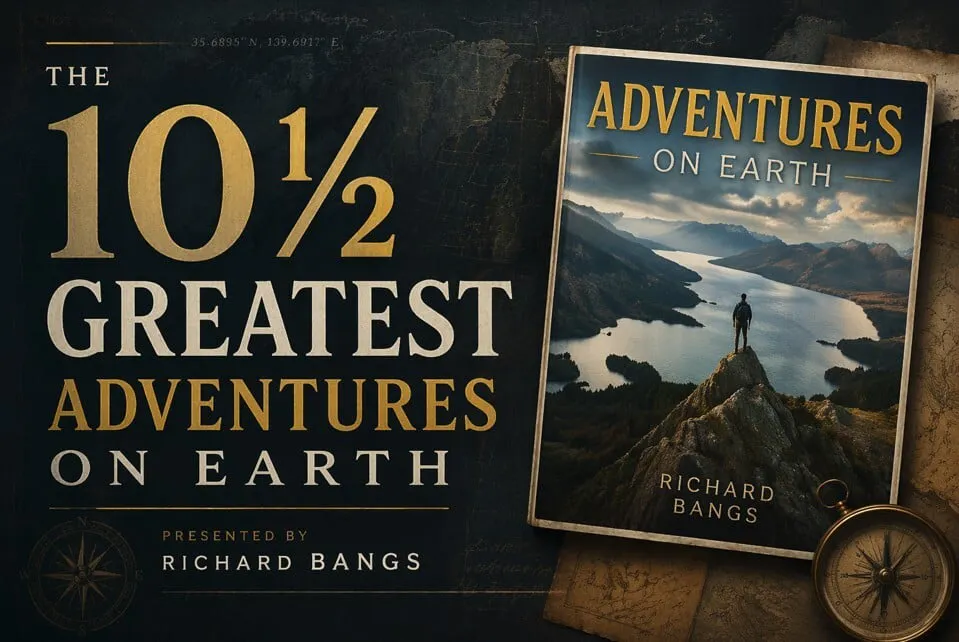
Watch this webinar where we’re joined by pioneering explorer, author, and MT Sobek co-founder Richard Bangs. Often called “the father of modern adventure travel,” Richard has spent more than half a century exploring some of the world’s most remote and remarkable places. In this webinar, he shares with us his new multimedia presentation called The 10½ Greatest Adventures on Earth, inspired by his latest book. Along the way, he reveals unforgettable stories, close calls, surprising moments of humor, and the lessons he’s learned after a lifetime of exploration.
Don’t miss your chance to learn from Richard and hear his stories!
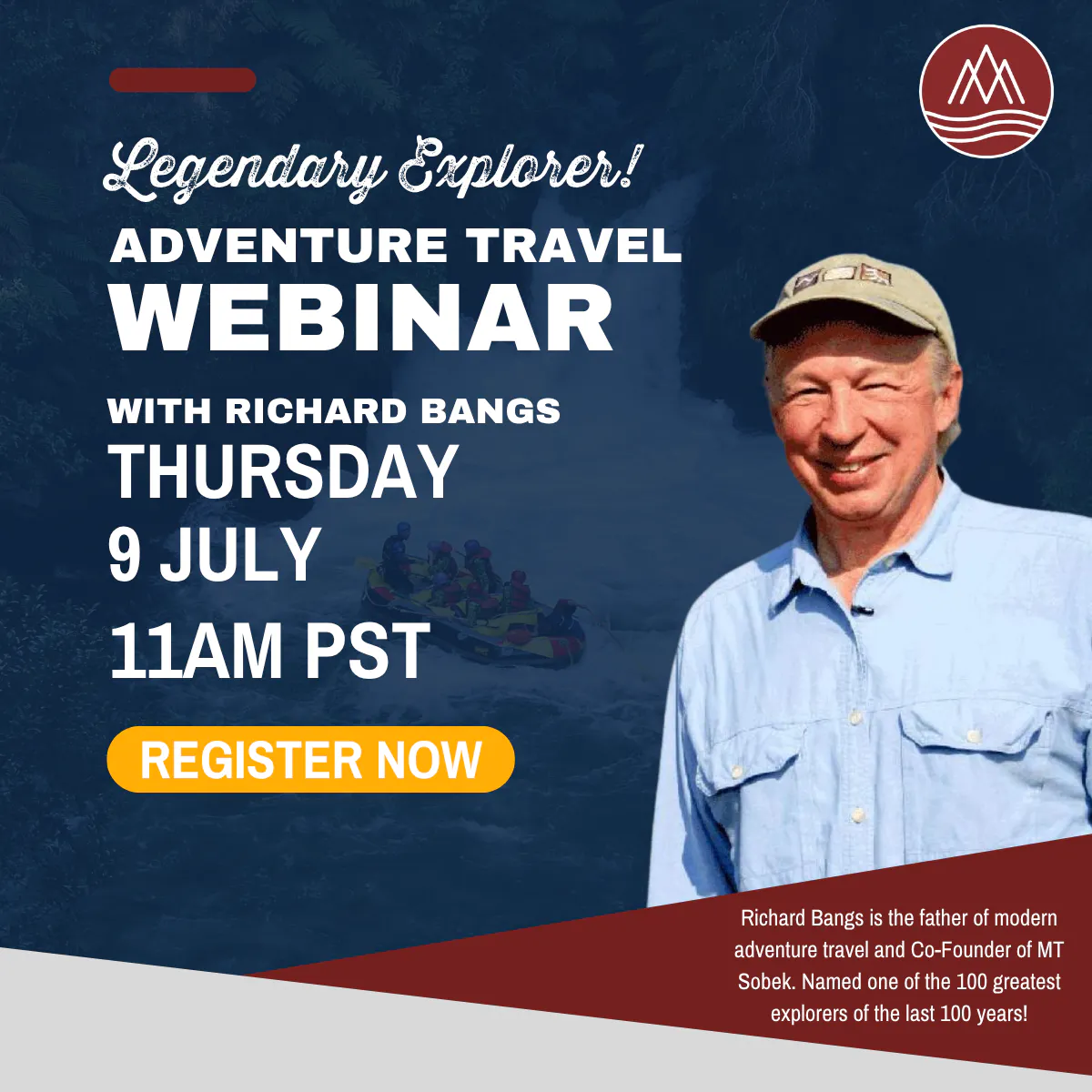

Table of contents
- What Makes an Adventure Truly Great?
- #10 Galapagos
- #9 Kilimanjaro
- #8 Tatshenshini-Alsek
- #7 Tour du Mont Blanc
- #6 Antarctica
- #5 Machu Picchu
- #4 Middle Fork of the Salmon River
- #3 Costa Rica
- #2 Norway
- #1 Nile
Hello everyone and welcome! We are thrilled to have you join us for this special event. We have a fantastic multimedia presentation, ahead, and I’m excited to be here with a true legend of adventure, Richard Bangs, who is here to explore the stories behind his new book, The 50 Greatest Adventures on Earth.
Often referred to as the Father of Modern Adventure Travel, Richard has been recognized as one of the 100 Greatest Explorers of the Past 100 Years. It’s a pleasure to welcome such an inspiring explorer of our time. So without further ado, Richard, thank you for being here. The floor is yours.
Thank you, Anne. I want to confess that AI gets some credit for this presentation, but it may not be what you think. I put this together over a few glasses of wine. So, in this case, AI stands for alcohol inspired.
There were probably thousands of adventures that we’ve been involved in over the years. And I was asked by my publisher to see if I could distill it down to the top 50. That alone was a tough exercise. It’s like trying to choose your favorite children, particularly if you’re an Arab Sheikh with 50 wives.
And I then decided that I should distill even further and present what might be my favorites, the top 10, over these decades of exploring and telling stories. Along the way, I’ve participated, I think, in over 30 first descents of wild rivers around the world. And beyond that, we’ve gone into places that were not particularly welcoming. And in many cases, they were the first. I led the first American trip into North Korea in modern times, one of the first into Iran, and the first American group into Libya. Between rivers, mountains, and wildernesses, I think we’ve covered a lot of ground.
What Makes an Adventure Truly Great?
Why were these the chosen adventures?
I think the greatest adventures reveal themselves through a blend of qualities: remoteness, cultural resonance, accessibility, and the elusive spark of glamour that has always drawn explorers toward the unknown. These aren’t necessarily the biggest or most extreme adventures.
Instead, they embody the qualities that have defined humanity’s most meaningful journeys.
They are landscapes shaped by powerful natural forces.
They are pathways where history, myth, and human endurance intersect.
They are places where the geological, ecological, and cultural energies of the planet converge.
Most importantly, they are regions still wild enough to transform the traveler who moves through them.
One of the photos I showed featured my two original partners, John Yost and George Wendt, who is unfortunately no longer with us.
To me, these adventures are living corridors of discovery—places where one feels both the ancient impulse to explore and the modern responsibility to understand, protect, and engage with the world’s remaining frontiers.
They are places where challenge, beauty, mystery, and meaning come together, offering not merely an experience but a deeper connection to the Earth and to ourselves.
#10: Why Is the Galapagos One of the Greatest Wildlife Adventures on Earth?
My number ten adventure is the Galapagos.
I spent nine years creating a series of PBS specials, and one of them featured these remarkable islands.
At first glance, the Galapagos don’t evoke wonder so much as something closer to dread. The landscape is barren, severe, ragged, and raw. Volcanoes still steam and fire. In some places the ground looks barely cool enough to step on.
It’s like the birthplace of the planet.
As a diver, I was especially excited to explore the islands underwater.
While heading out on a dive boat, I grabbed an apple as a snack. Later, while underwater, I felt something moving around in my mouth. I played with it using my tongue for a moment and eventually swallowed it.
When I surfaced, I discovered I had swallowed my front tooth.
As the host of a television show, this was not ideal.
The producers tried filming me from farther away, but no matter how distant the camera was, there was still a giant gap in my smile. Eventually I visited a Galapagos dentist who created an excellent temporary replacement tooth.
What impressed me even more was that when I tried to pay her, she refused to accept payment.
What Wildlife Makes the Galapagos Famous?
In the Galapagos Highlands, giant tortoises move with the certainty of creatures that have outlived empires.
They can live well beyond 100 years. Sit quietly with one long enough and the forest seems to rearrange itself around you. You begin to suspect that you are the visitor and the tortoise is the local historian.
The marine iguana is equally remarkable. It’s the only lizard on Earth that forages in the sea. It dives underwater to graze on algae and then sneezes excess salt from specialized glands.
To me, they look like retired dragons contemplating eternity.
The sea lions are another favorite. They’re social, playful, and endlessly curious.
One dive master told me that if I wanted to attract sea lions underwater, I should sing to them.
I tried.
Nothing happened.
When I surfaced, he asked what song I’d sung.
“Michael Jackson,” I replied.
He shook his head.
“No, no. They hate high voices. Try something lower.”
So I went back down and sang something deeper.
And it worked.
What Did Charles Darwin Discover in the Galapagos?
Of course, no discussion of the Galapagos would be complete without Charles Darwin.
As I joked during the presentation, I invited him to offer a few comments.
His observation still captures the essence of the islands:
“We arrived as though we were at the world’s very edge, where raw lava shores and dry air frame life’s most improbable persistence. Lizards basked on bare rock, birds moved entirely unafraid among people, and each island revealed forms shaped by isolation alone—as if nature had been quietly running her own experiments long before I arrived to take notes.”
Creation pared down. Purposeful. Wonderfully strange.
#9 Why Is Climbing Kilimanjaro One of the World’s Most Iconic Treks?
My number nine adventure is climbing Kilimanjaro, the tallest freestanding mountain on the planet.
A few weeks before my climb, I went diving in Hawaii. It was a relatively deep dive—around 80 to 100 feet. The next morning, I had booked a bicycle descent of Haleakalā, which rises to about 10,000 feet.
Not a great idea.
As I started down the mountain, my legs began to go numb. Then they started to seize up. Eventually, I couldn’t wiggle my toes, and the numbness began creeping farther up my legs.
It turned out I had a latent form of the bends.
I ended up in the emergency room, where doctors performed a spinal angiogram. Fortunately, I came out of it okay and spent a few days recovering in the hospital.
Of course, one of my first questions for the doctor was whether I could still climb Kilimanjaro, which was scheduled just a few weeks later.
He said, “You can go. But if you can’t wiggle your toes, head down as fast as possible.”
So I headed to Tanzania.
What Makes Kilimanjaro Unique?
Kilimanjaro rises like a misplaced dream above the savanna, its summit still holding the last scraps of equatorial ice.
It’s one of the only places on Earth where glaciers sit just three degrees south of the equator, although the mountain has lost more than 80 percent of its ice since 1912. If you’ve ever wanted to see tropical ice, now is the time.
Climbing Kilimanjaro is mostly a negotiation between gravity, oxygen, and your own optimism.
The mountain is so massive that it creates its own weather. During a single climb, you can move from rainforest to alpine desert to arctic ice.
The views arrive long before the altitude does, creating the strange sense that the world itself is holding its breath.
What Happened During My Summit Push?
Summit day began shortly after midnight.
I reached into my toiletry bag for my bottle of Zestril, the medication I took for blood pressure. But the cap had come off, and the bottle was empty.
Then I found another bottle—codeine.
Its cap had also come off.
At the bottom of the bag sat a pile of identical-looking pills scattered together in the darkness of the tent.
I needed the Zestril to help me get up the mountain. The problem was that one pill would help me continue climbing, while the other would put me into a deep, irresistible sleep.
So I picked one.
And swallowed it.
It would either propel me upward—or end my summit attempt before it began.
Fortunately, I chose the right one.
Soon enough, we stood atop the crown of an extinct equatorial volcano, higher than any ground east of the Andes and west of the Himalayas.
We stepped onto the summit and became part of the sky.
And yes—I could still wiggle my toes.
What Does Reaching the Summit of Kilimanjaro Feel Like?
At the summit of Kilimanjaro, exhilaration doesn’t arrive as a shout.
It arrives as a quiet, astonished exhale.
It’s the moment you realize you’ve climbed through five ecosystems, outrun your doubts, and somehow ended up standing in thin air where the world feels both vast and entirely yours.
There is a reason Kilimanjaro remains one of the great adventures of our time.
The mountain is not merely something you conquer. It’s something you experience.
Every step strips away distractions until only the essentials remain.
What Did Hemingway See in Kilimanjaro?
There is one writer who helped cement Kilimanjaro’s place in the adventure imagination: Ernest Hemingway.
During my presentation, I imagined what he might say about the mountain.
“Kilimanjaro rose clean from the plains. Approaching it felt inevitable, and oddly honest.
Some places don’t ask to be understood, only witnessed.”
I think that’s exactly right.
Kilimanjaro doesn’t demand analysis.
It doesn’t require explanation.
It simply asks you to show up, put one foot in front of the other, and witness it for yourself.
And that is precisely why it remains number nine on my list of the greatest adventures on Earth.
#8 What Makes the Tatshenshini River One of the Last Great Wilderness Expeditions?
My number eight adventure is rafting the Tatshenshini-Alsek River, a remarkable waterway that flows from the Yukon through British Columbia and ultimately into Alaska.
We made the first descent of this extraordinary river in 1976.
At its confluence with the Alsek River, it carries three times the flow of the Colorado River through the Grand Canyon.
And yet, despite its scale, it remains one of the wildest places I have ever experienced.
What Makes the Tatshenshini-Alsek So Extraordinary?
The Tatshenshini cuts directly through the St. Elias Range, home to the highest coastal mountains on Earth.
These peaks rise from riverside elevations to more than 18,000 feet in less than ten miles, creating one of the greatest vertical reliefs on the planet.
Most rivers are forced to fall off one side of a mountain range or the other.
The Tatshenshini does something very different.
It slices directly through the range itself.
That’s extraordinarily rare.
This is true wilderness. As you travel through the corridor, there is no sign of human presence. No roads. No towns. No indication that anyone has ever been there at all.
You are completely alone with the landscape.
Instead of people, you encounter a galaxy of glaciers.
What Wildlife Makes This Journey So Wild?
This region is home to more grizzly bears than almost anywhere else on Earth.
Ursa horribilis—the grizzly bear—may be the meanest quadruped in North America.
Here, they can consume up to 100 pounds of salmon a day.
Along the river, you’ll paddle past icebergs the size of office buildings while enormous mountains loom overhead like ancient gods deciding whether to grant passage.
The St. Elias Mountains contain the largest non-polar ice fields on Earth.
And if you’re lucky, you’ll see the Northern Lights.
One of the great surprises for many travelers is that the aurora doesn’t just look remarkable—it can sound remarkable as well. Under the right conditions, the lights produce a faint crackling sound, like radio static.
It’s something you have to experience to believe.
How Did We Help Protect the Tatshenshini Watershed?
One of my proudest memories connected to this river happened years after our first descent.
In 1988, British Columbia approved plans for what would have become the largest open-pit copper mine on the continent.
The project threatened the watershed.
Sulfuric acid contamination could have devastated the salmon runs and the bears, eagles, and ecosystems that depended on them.
The assumption was that nobody would notice.
They were wrong.
We noticed.
We launched a campaign and brought journalists from National Geographic and The New York Times. We invited politicians and conservation advocates. We brought as many people as possible into the region so they could understand what was at stake.
And remarkably, we succeeded.
British Columbia denied the mine leases and established Tatshenshini-Alsek Provincial Park, protecting the watershed.
Today it forms part of the vast Kluane/Wrangell–St. Elias/Glacier Bay/Tatshenshini-Alsek UNESCO World Heritage Site—one of the largest protected landscapes on Earth.
For someone who has watched many environmental battles end in disappointment, this was one we won.
And that victory remains as meaningful to me as any river descent.
#7 Why Is the Tour du Mont Blanc Considered Europe’s Greatest Hiking Adventure?
My number seven adventure is the Tour du Mont Blanc.
It is, quite simply, breathtaking.
Mont Blanc is what happened when the Alps decided subtlety was overrated. Standing here, it’s easy to understand why the Romantic poets fled the coal-fired smokestacks of industrial London in search of what they called the sublime—landscapes so vast and terrifyingly beautiful that they made humans feel gloriously insignificant.
Writers like Percy Shelley, Lord Byron, and Samuel Coleridge found inspiration in these alpine heights, where glaciers, avalanches, and impossible peaks became antidotes to the machinery of the modern age.
Why Were the Romantic Poets Drawn to Mont Blanc?
Away from the overcrowded cities of England, the Romantics came here searching for solitude, silence, and a decent place to hear themselves think.
Mont Blanc handed them chaos.
It offered cliffs like cathedral walls, glaciers groaning in the night, and the unsettling realization that nature was under no obligation to make humans feel important.
The poets—perhaps the first true adventure travelers—made pilgrimages to Chamonix in the early 1800s, escaping soot-blackened cities for alpine landscapes they believed could restore the soul.
They were right.
What Makes the Tour du Mont Blanc So Special?
Nature, of course, remains indifferent.
So does the alpine ibex, the mountain’s gravity-defying resident and ultimate vertical commuter. You’ll see plenty of them along the trail, navigating impossible slopes with casual confidence.
The Tour du Mont Blanc is the most beautiful circumnavigation in Europe.
It’s a roughly ten-day walk through three countries—France, Italy, and Switzerland. The beauty of the journey is that your luggage is carried ahead, leaving you free to focus on one thing: walking.
That’s it.
Just walk.
Forbes once called the Mountain Travel Sobek version of the trip the world’s most luxurious hiking adventure.
But luxury here isn’t about excess. It’s about immersion.
Why Do Mountains Continue to Inspire Awe?
As I once said in a PBS special:
Mountains fill the human spirit with awe and wonder.
They absorb the imagination, offering challenge, veneration, and exhilaration.
In early writings, they are associated with the divine. Mountains have both a physical and spiritual attraction.
That feeling remains as powerful today as it was centuries ago.
Did Adventure Travel Guiding Really Begin in the Alps?
Back in the 1980s, a magazine writer once described our company as the inventor of adventure travel guiding.
I confess that, for a brief moment, I believed it.
Feeling rather pleased with myself, I asked acclaimed mountaineering writer David Roberts to write an introduction to our next catalog—a glowing tribute to us as the originators of adventure guiding.
David quickly set me straight.
“I can’t do that,” he said. “The Company of the Guides beat you by about 150 years.”
Of course, he was right.
The original alpine guides were the crystal hunters of the Alps, hired by Romantic-era travelers to lead them into the mountains during the 1800s.
We’ve since partnered with the Company of the Guides on many trips, and it has been one of the most rewarding relationships of my career.
What Is It Like to Travel Through the Alps?
Part of the magic of the Tour du Mont Blanc isn’t just the mountains.
It’s everything that comes with them.
We linger in storybook chalets. We sample alpine cheeses and chocolates. Evening light filters through glasses of wine and grappa.
Every meal feels like a celebration.
And then there is absinthe—the Green Fairy.
Banned in 1910 and legal again since 2005, it remains one of my favorite alpine indulgences.
Absinthe, after all, makes the heart grow fonder.
What Does It Feel Like to Complete the Tour du Mont Blanc?
Completing the Tour du Mont Blanc brings a special kind of satisfaction.
The only side effect, as far as I can tell, is that altitude may temporarily improve creative expression—from poetry to dancing.
There is something about spending days surrounded by immense mountains that strips life down to essentials.
You walk.
You breathe.
You notice.
And gradually, all the noise begins to fade away.
What Did Percy Shelley See in Mont Blanc?
Perhaps no writer captured the spirit of Mont Blanc better than Percy Shelley.
As I imagined during my presentation, he might have said:
“Mont Blanc rises above everything—steady, imposing, impossible to ignore.
Up there, everything simplifies. The noise drops away and you’re left with perspective.
The power isn’t loud. It’s in the stillness.
And Richard, trying to explain it like this is probably not enough.
It’s something you have to feel.”
I couldn’t agree more.
The Tour du Mont Blanc isn’t simply a hike.
It’s an opportunity to step into one of the landscapes that helped shape the modern idea of adventure itself.
And that’s why it remains number seven on my list of the greatest adventures on Earth.
#6 Why Does Antarctica Remain the Ultimate Expedition Cruise?
My number six adventure is Antarctica.
We conducted our first Antarctica expedition in 1978, and I believe we were the first travel company to do so.
We came searching for the edge of the world.
What we found was nature’s cathedral.
Boating here feels less like exploring geology and more like floating into a frozen sapphire.
Why Has Antarctica Fascinated Explorers for Centuries?
For centuries, cartographers and geographers speculated about the existence of a vast continent in the far south—a Terra Australis Incognita that would balance the extensive landmasses of the Northern Hemisphere.
Antarctica was finally sighted in 1820 by Russian explorer Fabian Gottlieb von Bellingshausen, with the first confirmed landing credited to American sailor John Davis in 1821.
Today, more than 100,000 adventure travelers visit the last continent each year.
Even now, Antarctica remains one of the few places on Earth that feels larger than human imagination.
What Makes Antarctica Feel So Different From Anywhere Else?
Nothing recalibrates your sense of scale quite like having a humpback whale surface beside your kayak and casually exhale what feels like the GDP of a small nation.
Humpback whales can grow to 60 feet long and communicate through haunting underwater songs that travel for hundreds of miles.
I like to think of those songs as the original Antarctic podcast.
Then there are the Adélie penguins.
They live in a world without land predators, which explains their remarkable confidence. They may weigh only ten pounds on a generous day, but they carry themselves with the attitude of a New York taxi driver.
They rocket from the sea at nearly twenty miles an hour—nature’s tuxedo torpedoes.
And boy, can they dance.
One of our chief guides, Jonathan Chester, served as chief consultant for the film Happy Feet, so we can take at least a little credit for their cinematic career.
What Are the Most Memorable Wildlife Encounters in Antarctica?
Antarctica can be astonishingly quiet.
Then, without warning, a whale erupts from the icy water.
In the frozen hush, it feels like watching a myth remember its own name.
A single breach can shatter the silence with an exclamation mark of pure wildness.
Moments like these remind you that Antarctica isn’t simply a destination.
It’s a place where nature still writes the rules.
How Did I End Up Taking Bill Gates to Antarctica?
One of the more unusual adventures connected with Antarctica began with a phone call from Bill Gates.
His son Rory was studying Antarctica and struggling with the topic. Bill wanted to take him there, along with Bill’s father, but there was a challenge.
He had only nine days.
Weather was uncertain. We were at the edge of the Antarctic season. The entire undertaking looked difficult.
We said we’d try anyway.
The logistics were enormous.
We signed confidentiality agreements so nobody would know the identity of the travelers. As we arranged transportation, security, medical support, and other services, we had to tell people it was a high-profile guest without revealing who it actually was.
So I came up with a solution.
I told everyone it was Billy Joel.
Strangely enough, that worked perfectly.
Throughout the process, people became very excited about the prospect of meeting Billy Joel. Some were undoubtedly disappointed when the truth eventually emerged.
What Was Unique About That Antarctic Expedition?
Ultimately, we succeeded.
Working with the Chilean Air Force, we arranged what was, at the time, one of the first commercial fly-in tourist experiences to Antarctica.
Today it’s common.
Back then, it was groundbreaking.
We also managed to arrange a visit to Palmer Station, which was generally closed to tourists.
The staff were not particularly interested in meeting Billy Joel.
Fortunately, Bill Gates agreed to let me use his real name for that portion of the trip.
The station staff expected him to stay for an hour.
He stayed for three.
And then we arranged something even more unusual.
Because it was the austral summer and the sun never truly set, we organized an overnight camp on the ice. At the time, almost nobody was doing that.
Today it has become much more common, but back then it felt extraordinary.
What Would Ernest Shackleton Say About Antarctica?
No Antarctic discussion would be complete without Ernest Shackleton.
I invited him, at least in spirit, to offer a few words.
His advice was predictably direct:
“Richard, my boy, Antarctica does not welcome you; it tests you.
Endurance, Richard, is everything.”
That may be the most concise description of Antarctica ever given.
The continent demands respect.
It rewards patience.
And it has a way of revealing exactly who you are.
Why Is Antarctica One of the Greatest Adventures on Earth?
Antarctica strips away distractions.
There are no cities. No crowds. No noise.
Just ice, light, wind, wildlife, and an overwhelming sense of wonder.
It is one of the few places left where you can genuinely feel as though you’ve reached the end of the map.
For that reason, Antarctica remains number six on my list of the greatest adventures on Earth.
#5 Why Is the Sacred Valley and Machu Picchu One of South America’s Greatest Journeys?
My number five adventure is the Sacred Valley and Machu Picchu in the Inca heartland of Peru.
The Inca Trail is not merely a path through geography.
It is a pilgrimage through time, architecture, and the human spirit.
For me, it remains the most spectacular trek in South America.
What Makes the Inca Trail So Special?
The journey begins in Cusco, the ancient capital of the Inca Empire and, according to some, the oldest continuously occupied settlement in the Western Hemisphere.
At more than 10,000 feet above sea level, Cusco stands high above Machu Picchu itself.
From there, the trail unfolds as both engineering marvel and cultural treasure.
The Inca Trail is not simply a hiking route.
It is a work of art.
It forms part of one of the largest road networks in the ancient world, climbing to Dead Woman’s Pass at 13,776 feet.
Hiking the trail, history feels close enough to touch.
The past seems real, but just out of reach, like a shiny coin trapped beneath a grate.
Why Does Machu Picchu Continue to Fascinate Travelers?
From the Sun Gate, Machu Picchu reveals itself like one of archaeology’s greatest question marks.
Its origins remain remarkably mysterious.
For centuries, it sat hidden beneath clouds and jungle until Hiram Bingham brought international attention to it in 1911.
Even today, questions remain.
Who built it?
Why was it built?
With its stairways, terraces, temples, and stonework, Machu Picchu feels like a Möbius strip of paradox and possibility.
Many believe it was a religious center.
Others see it as a university for priests.
Some argue it was a royal refuge, an observatory, a military outpost, or even the legendary El Dorado.
And yes, there are those who insist it was connected to ancient extraterrestrials.
The truth?
Only the ghosts of the Incas know for certain.
What Memory Stands Out Most From My Time in Machu Picchu?
I once took my son Jasper there when he was a preteen.
Of all the incredible ruins and landscapes we experienced, his favorite memory was surprisingly simple.
He attempted interspecies communication with a llama.
The llama responded by spitting directly in his face.
Memorable.
What Were Hiram Bingham’s First Impressions of Machu Picchu?
I also imagined asking Hiram Bingham himself for his thoughts.
His answer was brief:
“Extraordinary.
Hidden among the clouds, untouched for centuries, what we have here is no mere ruin, but a royal refuge of the Inca.”
It’s hard to improve upon that description.
Why Does Machu Picchu Belong Among the Greatest Adventures on Earth?
The Sacred Valley and Machu Picchu combine everything I love about adventure travel.
History.
Mystery.
Physical challenge.
Cultural discovery.
And the rare feeling that you’re walking through a place that still guards some of its secrets.
Even after all these years, Machu Picchu remains one of the few destinations that asks more questions than it answers.
And that’s exactly why it deserves its place among the greatest adventures on Earth.
#4 Why Is the Middle Fork of the Salmon Known as the River of No Return?
My number four adventure is the Middle Fork of the Salmon River.
The first question people usually ask is this:
Why is it called the River of No Return?
The answer goes back to the late 1800s and early 1900s, when miners, trappers, and homesteaders floated heavy wooden sweep boats down the river to reach remote mining claims or move timber downstream toward Portland.
The problem was that once they went down, they couldn’t come back.
The river’s steep gradient, endless boulder gardens, and nearly continuous whitewater made upstream travel virtually impossible.
It was a one-way journey.
Why Did the River of No Return Capture My Imagination?
The Middle Fork also inspired one of my favorite films of all time: River of No Return, starring Marilyn Monroe and Robert Mitchum.
In the early 1990s, I attended a party at Robert Mitchum’s home in Santa Barbara and found myself asking what was probably a very predictable question.
“What was your favorite film?”
He looked at me and said he didn’t watch his films. He didn’t enjoy watching himself on screen. Acting, he explained, was simply a job.
Still, I pressed him.
Surely there was one film he particularly enjoyed.
Without hesitation, he answered:
“River of No Return.”
He said it was far and away the most fulfilling cinematic experience he ever had.
I understand exactly why.
What Makes the Middle Fork of the Salmon So Special?
The river drops roughly 3,000 feet in just 100 miles, making it one of the steepest navigable big-water rivers in North America.
The early river runners surrendered themselves to its downhill pull because there was simply no fighting it.
The current was too insistent.
The canyon walls were too sheer.
The wilderness was too absolute.
They went in one direction only: forward.
Like all the journeys that ultimately matter.
Today, what was once feared has become one of the greatest river-running adventures on Earth—a wild corridor where solitude, history, and whitewater combine into something unforgettable.
Is It All About the Rapids?
Not even close.
One of the great surprises of the Middle Fork is that the rapids are only part of the experience.
The landscape seems to produce moments that feel almost supernatural.
Looking at certain photographs from the river, I sometimes wonder:
Are we witnessing divine intervention?
Celestial approval?
Aliens conducting field research after visiting Machu Picchu?
All we really know is that a couple of guides disappeared from one photograph, and I continue to blame the mysterious circumstances.
The river has a sense of humor that way.
What Wildlife Can You Encounter Along the River?
One memorable image from the trip featured a creature caught between a croc and a hard place.
Thankfully, unlike some of the rivers I’ve explored in Africa, there are no large aquatic apex predators lurking beneath every bend.
That’s one less thing to worry about.
The wilderness here is dramatic enough without crocodiles participating.
Why Are the Guides Such an Important Part of the Experience?
One of the things that makes the Middle Fork so extraordinary is its guides.
They guide by day and somehow transform into gourmet chefs by night.
I’ve long believed that the true test of an expedition is not how the guides handle the rapids.
It’s how they handle dinner.
The rapids may test your mettle.
The river chefs decide your fate.
One minute you’re navigating Class IV whitewater. The next you’re sitting down to a backcountry feast so good it feels as though it should require a permit.
What Does a Perfect Day on the Middle Fork Look Like?
For me, the perfect Middle Fork day includes what I call the Holy Trinity of the wilderness:
- Firelit storytelling
- A hot spring soak
- River-cooled fly fishing
It’s proof that even in the wild, indulgence can be a perfectly balanced survival strategy.
This isn’t simply an itinerary.
It’s a slow, deliberate return to the things that actually matter.
The river strips life down to essentials, but somehow leaves room for comfort, friendship, great food, and unforgettable stories.
Why Does the Middle Fork Belong Among the Greatest Adventures on Earth?
The Middle Fork of the Salmon occupies a rare place in the adventure world.
It offers genuine wilderness without sacrificing beauty.
It delivers excitement without losing its sense of peace.
It reminds us that some of the finest journeys aren’t about getting somewhere.
They’re about surrendering to the current and allowing the river to carry you forward.
That’s why the Middle Fork of the Salmon remains number four on my list of the greatest adventures on Earth.
#3 Why Does Costa Rica Embody the Spirit of Adventure Travel?
My number three adventure is Costa Rica.
Years ago, I filmed a PBS special there and described it as the ecological nexus between North and South America—a small but potent package of a country.
The people of Costa Rica have worked tirelessly to preserve their extraordinary biodiversity.
And from everything I’ve seen, it’s working.
What Was My Most Embarrassing Travel Moment in Costa Rica?
I’ve visited Costa Rica several times over the years.
On one visit, I arrived in San José after flying all the way from India by way of Los Angeles.
I’m not particularly good with jet lag, and this trip hit me especially hard.
My host invited me for a drink.
I accepted.
After finishing a gin and tonic, I noticed another one waiting.
Then another.
At some vague point later in the evening, I vaguely remember dancing before finally stumbling back to my hotel room and collapsing into bed.
Sometime during the night, I woke up and headed toward what I thought was the bathroom.
Still half asleep, and apparently convinced I was back in New Delhi, I walked down the hallway, opened a door, stepped through it, and heard a click behind me.
I turned around.
I had locked myself out.
Completely naked.
In the hallway of the Grand Hotel.
Not one of my more elegant travel moments.
Why Is Costa Rica One of the World’s Great Adventure Destinations?
When Christopher Columbus arrived here on his fourth voyage in 1502, he named it Costa Rica—”Rich Coast.”
Whether he was imagining gold and silver or not, the name proved fitting.
The true riches of Costa Rica were never buried underground.
They’re everywhere around you.
This is a place that resembles humanity’s vision of paradise.
A kind of Garden of Eden.
And like every version of Eden, it exerts a powerful pull.
What Does ‘Pura Vida’ Really Mean?
For some of us, life is simply the interlude between paddling trips.
Costa Rica understands that philosophy.
The national phrase, Pura Vida—the Pure Life—is more than a slogan.
It is a worldview.
It represents a society that has chosen happiness, simplicity, and connection over unnecessary complexity.
I don’t believe Pura Vida created Costa Rica’s uniqueness.
I think it is the expression of it.
Why Is Costa Rica So Exciting for Adventure Travelers?
Costa Rica allows wildness to flourish.
Zip-lining through the canopy feels like flying without an airplane.
It’s a leap of faith.
And once you’ve taken that leap, your worries remain on the platform behind you.
The country’s rivers, rainforests, wildlife, volcanoes, and coastlines offer virtually endless opportunities for adventure.
Everywhere you look, monkeys howl.
Parrots and macaws cut across waterfalls.
Whitewater rivers surge through jungles.
Life splashes you directly in the face.
Who Helped Shape Modern Ecotourism in Costa Rica?
A dear friend of mine, Mike Kaye, deserves a great deal of credit for what Costa Rica has become.
Mike pioneered many of Costa Rica’s early whitewater rivers and eventually became known as the godfather of ecotourism.
He arrived in the 1970s, when Costa Rica was still considered a banana republic.
He helped establish some of the first ecolodges and championed the concepts of sustainable and responsible travel long before they became industry buzzwords.
His influence remains visible throughout the country today.
Why Are Costa Ricans So Happy?
Costa Ricans are frequently described as some of the happiest people on Earth.
I’ve often wondered which came first.
Did they create one of the world’s most successful societies because they’re happy?
Or are they happy because they created such a successful society?
Whatever the answer, there is an obvious and admirable pursuit of the good life here.
The towering trees, intricate rainforest canopies, and vibrant ecosystems feel like the physical architecture of happiness itself.
This is Pura Vida.
And that is why Costa Rica ranks number three among my greatest adventures on Earth.
#2 Why Is Norway One of the World’s Most Spectacular Adventure Destinations?
My number two adventure is Norway.
I featured Norway in one of my PBS specials and opened with a question that still fascinates me:
A thousand years ago, Vikings set sail from these fjords, striking fear across Europe. Yet today, this severely beautiful country is home to the Nobel Peace Center.
How did such a progressive nation emerge from such a fierce past?
The answer is woven into the landscape itself.
What Makes Norway’s Fjords So Extraordinary?
Norway’s fjords aren’t just scenic.
They’re among the deepest and cleanest waterways on Earth, with visibility so clear that divers often describe it as swimming through glass.
This Nordic wonderland is home to more than 300 mountain peaks above 6,000 feet, many accessible by marked trails. It is one of the most hiker-friendly countries in the world for travelers who crave both altitude and serenity.
The earth here seems to practice its victory poses.
Stand on a ledge overlooking a fjord, and you can feel the land flex beneath you. Raise an arm, and it almost seems as though the mountains raise one back.
Why Do Norway’s Landscapes Feel Larger Than Life?
Norway’s coastline stretches more than 60,000 miles when you include its fjords and islands.
Jagged peaks tumble into mirrored waters. The sky catches fire at sunset. Somewhere in the distance, a fisherman is probably composing existential poetry while gutting cod.
Everything here feels amplified.
The scale.
The silence.
The beauty.
It’s the sort of place that reminds you how small you are and somehow makes that feel wonderful.
Why Is Bergen One of Norway’s Most Charming Cities?
Bergen’s waterfront dates back to the Hanseatic League of the 14th century, when German merchants transformed this rainy outpost into one of northern Europe’s great trading hubs.
In 1903, Roald Amundsen departed from here on his quest to navigate the Northwest Passage.
Today, Bergen looks like a town designed by a cheerful watercolor painter with a Viking ancestry problem.
The harbor glows in impossible colors.
Fishing boats bob like tipsy seabirds.
Every window seems illuminated by someone brewing coffee strong enough to survive a North Sea winter.
What Wildlife Can You Experience in Norway?
Norway is home to more than 200,000 wild reindeer, the last great wild herds in Europe.
They migrate farther than any other land mammal on the continent, with some herds traveling more than 300 miles each year along routes established since the last Ice Age.
Watching them cross the tundra feels like witnessing a migration that has been taking place forever.
Because, in many ways, it has.
Why Does Norway Feel Like a Natural Movie Set?
Norway’s fjords were carved by glaciers up to 3,000 meters thick.
What remains is one of the most dramatic landscapes on Earth: steep cliffs plunging directly into deep blue water.
It’s a masterclass in scale, drama, and humility.
It’s also why Norway has become the backdrop for some of the most ambitious films ever made.
What Would a Hollywood Stunt Performer Say About Filming in Norway?
During the presentation, I joked that I had invited Tom Cruise to join us.
He wasn’t available.
Apparently he was busy doing all of his own stunts.
Fortunately, I found a fellow who claimed to be Tom Cruise’s stunt double and persuaded him to offer a few remarks.
He described filming in Norway this way:
“Filming out there is different.
I remember standing on a narrow ridge with snow blowing off the fjord. The crew looked at me like, ‘You sure?’
And I’m thinking, how could you not do this for real?
No stage comes close.
The helicopter is circling overhead and you only get a few seconds.
Suddenly it’s not a shot. It’s a moment.
Norway doesn’t fake anything.
It makes you show up for real.
Sometimes that means hanging off a cliff and wondering whether what you’re doing is brilliant or a mistake.
But when you watch it afterward, you realize it wasn’t just the landscape that looked alive.
It made everything alive.”
That captures Norway perfectly.
It demands your attention.
And it rewards it.
Why Does Norway Rank Among My Greatest Adventures?
Norway combines rugged wilderness, deep history, extraordinary scenery, and a culture that seems perfectly adapted to life among mountains, sea, and weather.
It feels ancient and modern at the same time.
Wild and welcoming.
Powerful and peaceful.
Few places have left such a lasting impression on me.
That’s why Norway ranks number two on my list of the greatest adventures on Earth.
#1 Why Is the Nile My Number One Adventure on Earth?
My number one adventure is the Nile Cultural Discovery Tour.
This is a personal list, of course, and everyone would create their own rankings.
But the Nile means something special to me.
It is deeply connected to Mountain Travel Sobek itself.
After all, Sobek is the ancient Egyptian crocodile god worshipped along the Nile.
Why Is Sobek So Important to Me?
When we founded Sobek, we were running many of Ethiopia’s great rivers, including the Blue Nile.
As I researched the region, I became aware of the many ways one might meet their maker along the Nile system.
There were difficult river conditions.
There were local conflicts.
There were tropical diseases, including schistosomiasis.
There were hippos, lions, hyenas, crocodiles, and enough poisonous snakes to keep anyone alert.
I once joked that of the ten most poisonous snakes in the world, the Nile somehow seemed to host thirteen of them.
During that time, I found a book in the Library of Congress about Sobek, the ancient crocodile deity who was believed to grant safe passage to those who paid him proper respect.
We decided that sounded like a reasonable strategy.
Fortunately, it worked out pretty well.
What Makes the Nile One of the World’s Greatest Cultural Journeys?
The Nile is more than a river.
It is one of humanity’s great corridors of civilization.
As I like to say:
Sobek, lord of the Nile, shaped Egyptian culture, influenced religion, and empowered pharaohs themselves.
It was said that the waters of the Nile were the sweat of Sobek.
It’s difficult to imagine now, but crocodiles once filled these riverbanks.
Traditional feluccas have sailed these waters for more than 4,000 years using essentially the same sail designs that carried pharaohs, merchants, and explorers.
Every journey on the Nile feels like a voyage through living history.
Why Did Ancient Egypt Flourish Along the Nile?
The Nile possesses one extraordinary advantage.
Its winds push boats upstream while its current carries them downstream.
Very few rivers in the world offer such effortless navigability.
That natural transportation corridor helped create one of the greatest civilizations in human history.
The Great Pyramid of Giza remained the tallest human-made structure on Earth for nearly 3,800 years.
Even today, engineers marvel at how precisely it was built.
These monuments were not simply tombs.
They were designed as gateways to eternity.
Ancient elevators to a higher floor.
What Is It Like to Experience Egypt from the Air?
Egypt’s desert skies are among the cleanest on Earth.
A hot-air balloon ride here is perhaps the closest humans come to borrowing the sunrise itself.
As you rise above the landscape, the world unfolds below like an enormous relief map carved by wind, worship, and time.
It’s a view that reminds you how long civilizations can endure when they understand patience.
Why Is the Nile So Mysterious?
For thousands of years, one question baffled the ancient world.
How could a river flowing through vast desert landscapes flood during the dry season?
Greek, Persian, and Roman rulers all tried to solve the mystery.
Alexander the Great tried.
Julius Caesar tried.
Even Emperor Nero funded expeditions.
All failed.
The answer wasn’t fully understood until the nineteenth century.
The Nile guarded its secrets remarkably well.
What Did John Hanning Speke Say About Discovering the Source of the Nile?
During my presentation, I imagined remarks from John Hanning Speke.
His response was refreshingly honest:
“To be fair, I did not discover the Nile.
Local people had known these waters for generations.
They understood them far better than any outsider could.
What I sought was its beginning.
Standing on the shores of Lake Victoria, certainty arrived all at once.
After years of doubt and distance, everything aligned.
I knew I had found where it begins.”
His famous rival, of course, was Richard Burton.
Together, they helped create one of exploration’s greatest stories.
Why Does the Nile Rank Number One on My List?
The Nile combines everything I value in adventure travel.
History.
Exploration.
Culture.
Mythology.
Geography.
Storytelling.
No other journey has influenced me more personally or professionally.
It connects ancient civilizations to modern travelers.
It links adventure with understanding.
And every time I return, I discover something new.
That is why the Nile remains number one on my list of the greatest adventures on Earth.
What’s Next for Richard Bangs?
Those are my personal top ten adventures—the journeys I return to again and again whenever I have the opportunity.
But if you can’t hit the road right away, the next best thing I’ve found is reading a great adventure book.
And there are still plenty more stories to tell.
Before closing, I wanted to share an upcoming trip that is especially meaningful to me.
I invite anyone with the time, curiosity, and desire for adventure to join me on a Kenya Walking Safari this October and November.
This journey is deeply personal.
Back in 1973, I completed the first descent of Ethiopia’s Omo River. The Omo ultimately flows into Lake Turkana, which lies in Kenya. While 99 percent of the river is in Ethiopia, the story doesn’t really end there.
That expedition changed my life.
I believe it changed the lives of many people who followed in our wake as well.
Yet there was one problem.
We were unable to cross the border.
A piece of the puzzle remained unfinished.
For decades, that unfinished chapter stayed with me.
On this unique safari, we will visit Lake Turkana—a destination few travelers ever experience and one that has fascinated me for years.
My interest in Lake Turkana began long before we developed this journey.
One of my favorite books from the 1970s was Iscales of Morning: The Mingled Destinies of Crocodiles and Men, written by Alastair Graham and photographed by Peter Beard.
Peter Beard went on to become famous for many reasons, including his work with model Iman and his extraordinary photography throughout Africa.
I later had the opportunity to work with Peter myself.
One of the most memorable images he ever created was a self-portrait taken from inside the jaws of a crocodile.
That tells you something about Peter Beard.
And it tells you something about Lake Turkana.
Lake Turkana contains more Nile crocodiles than anywhere else on Earth.
Graham and Beard spent a year there studying them, documenting a landscape that remains one of Africa’s most remote and captivating environments.
For me, visiting Turkana feels like completing a circle that began more than fifty years ago.
It’s an opportunity to revisit a story that helped shape my life and finally explore a chapter that remained unfinished.
Some adventures stay with you.
This is one of them.
We ask the audience for questions they want to ask Richard Bangs.
What Was Richard Bangs’ Most Difficult Adventure?
Given how long we’ve been doing this, there have certainly been expeditions where things didn’t go according to plan.
In fact, for many people, that’s the very definition of adventure travel: a well-planned trip that goes awry.
One place we badly underestimated was the Indus River in Pakistan.
We made the first descent, and it was unlike anything we had encountered before.
The Indus is the seventh-largest river in the world, fed by glacial waters pouring down from K2 and the Karakoram Range.
Its scale is almost impossible to comprehend until you’re actually on it.
We flipped more than once.
At one point, we had a cameraman sucked underwater. He survived, fortunately, but the experience left a lasting impact.
Despite all our preparation and experience, the river proved more powerful than anything we had anticipated.
Eventually, we were forced to pull the boats out and walk the final stretch because the conditions simply became too dangerous to navigate.
To the best of my knowledge, very few people have successfully completed the entire route since our descent.
That’s certainly one of the hardest expeditions I’ve ever experienced.
And there have been many.
What Is the Most Unique Trip Richard Bangs Helped Pioneer?
The truth is that we’re always searching for unique adventures.
Pioneering new experiences has always been part of our DNA.
As the world changes, closes, and reopens, we try to be among the first to explore, interpret, and understand emerging destinations.
Why Was North Korea Such a Meaningful Achievement?
For me, one of the most satisfying accomplishments was North Korea.
I spent years lobbying politicians in Washington and pursuing every contact I could find inside North Korea.
It was a long process.
Eventually, we secured permission to bring the first American group into the country in modern times.
When we announced the trip, we had space for just 22 people.
Within 24 hours, more than 50 people had signed up.
Demand was so strong that authorities permitted us to operate two back-to-back departures.
The experience was deeply satisfying, not only because we succeeded, but because it reflected what adventure travel can do at its best.
It allows us to engage with places that are often misunderstood.
I’ve always been interested in destinations that are viewed through a simplified lens.
North Korea was one example.
Iran is another.
Both places have complicated histories and political realities, but both also contain far more nuance, culture, and human stories than many outsiders realize.
Part of adventure travel’s responsibility is helping people see beyond stereotypes.
The greatest journeys aren’t always to the most beautiful landscapes.
Sometimes they are journeys toward understanding.
Has Richard Bangs Had Trouble with Crocodiles?
The short answer is yes.
Quite a bit.
Over the years, we’ve had boats bitten by crocodiles.
We’ve had boats bitten by hippos as well.
Neither experience is especially enjoyable.
But one story stands out.
What Happened During the Omo River Crocodile Incident?
During the first descent of Ethiopia’s Omo River, my friend George Fuller served as both expedition doctor and aspiring filmmaker.
By about the twentieth day of the trip, George was becoming increasingly frustrated.
Despite all the crocodiles we’d seen, he still hadn’t captured good footage of one.
The problem was that crocodiles are surprisingly shy.
Whenever one charged our boats, we used what we jokingly called “croc rocks.”
As a crocodile approached, we’d throw rocks near it. The crocodile would immediately dive underwater and disappear.
George finally asked us for a favor.
The next time a crocodile charged, he wanted us to hold our fire so he could capture better footage.
Against our better judgment, we agreed.
The next crocodile that appeared was enormous.
George happily kept filming as it raced toward the raft.
He filled his camera’s viewfinder with crocodile.
And then he realized the crocodile wasn’t stopping.
The animal reached the boat and clamped its jaws around the bow of the inflatable raft.
Suddenly, George wasn’t filming a nature documentary anymore.
He was filming a crocodile eating his boat.
The crocodile became tangled in the raft’s fabric.
Once attached, it began shaking the boat back and forth like a dog playing with a rag doll.
George jumped onto the oars.
Meanwhile, his wife Diane sprang into action.
She rushed to the front of the raft carrying a metal bailing bucket and began hammering the crocodile on the head.
Again.
And again.
And again.
Eventually, the crocodile released its grip and disappeared.
Everyone made it safely to shore.
The raft, however, was effectively finished.
We rolled up what was left of it and continued downstream.
Adventure sometimes demands improvisation.
In Conclusion: Why Do the Greatest Adventures Stay With Us?
After a lifetime of expeditions, I’ve learned that the most memorable stories are rarely the ones you planned.
They’re the unexpected moments.
The complications.
The mistakes.
The challenges that force you to adapt.
Sometimes adventure looks like standing on top of Kilimanjaro.
Sometimes it looks like floating through Antarctica beneath a midnight sun.
And sometimes it looks like watching a crocodile attempt to consume your raft while your teammate beats it with a bucket.
All three have their place.
Looking back on these journeys—from the Galápagos to Kilimanjaro, from Antarctica to the Nile—I’m reminded that adventure is rarely about checking destinations off a list.
It’s about transformation.
The greatest adventures challenge us.
They humble us.
They surprise us.
They introduce us to extraordinary landscapes, remarkable wildlife, fascinating cultures, and often to versions of ourselves we didn’t know existed.
The rivers, mountains, deserts, glaciers, forests, and ancient civilizations I’ve been fortunate enough to encounter have all offered something different.
But they’ve all shared one thing in common:
They changed me.
These adventures are not simply places.
They are stories.
They are teachers.
They are reminders that the world remains larger, wilder, and more astonishing than we often imagine.
And that, ultimately, is why I keep returning.
Enjoying our content? Add MT Sobek as a Google Preferred Source.


