Why Every Hiker Should Take a Multi-Day Rafting Trip Down the Middle Fork of the Salmon
Middle Fork guide Owen Thompson explains why every hiker should raft the Middle Fork of the Salmon—plus 6 favorite side hikes along the river.

If you’re a hiker, you know the exhilarating feeling of leaving the busy parking lot at the trailhead behind and watching civilization disappear the deeper into the wilderness you step.
The farther you walk, the quieter it gets. The landscape opens up around you. Your pace slows. Eventually, the only things that matter are the ground beneath your feet, the people you’re with, and whatever the wilderness has in store for you that day.
But what if you could experience that same feeling of getting away—while traversing these remote and awe-inspiring landscapes in an entirely different way?
That’s where a multi-day rafting trip down Idaho’s Middle Fork of the Salmon River comes in.
For a hiker, the Middle Fork offers both a familiar and unique experience as you explore up to 100 miles of river over 6 days through the Frank Church-River of No Return Wilderness—nearly 2.4 million acres of protected backcountry and one of the largest wilderness areas in the lower 48.
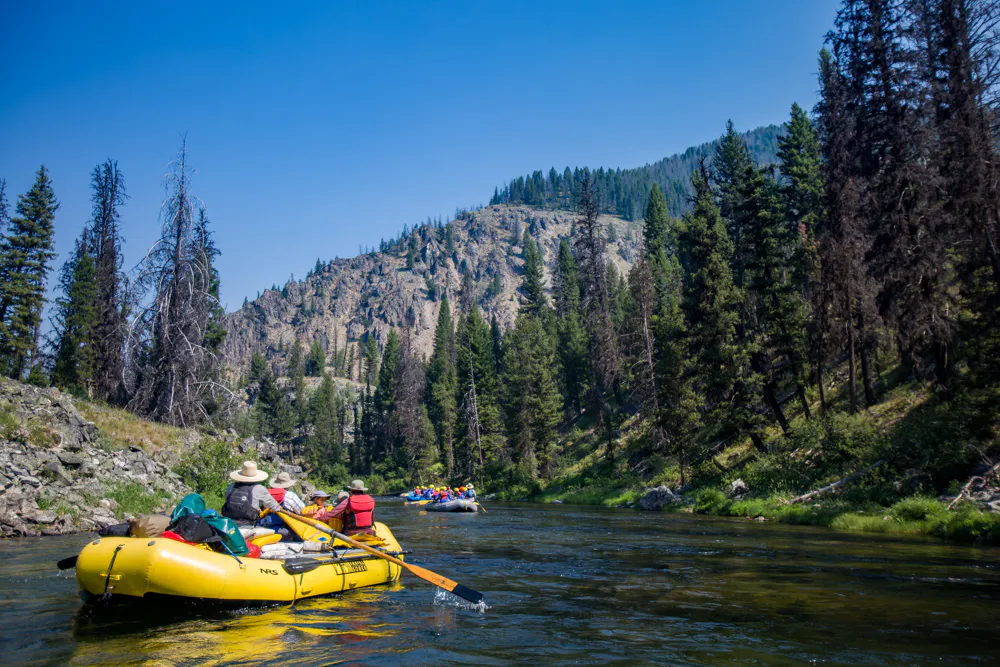
You still get the wildlife, the mountainous scenery, the good company seeking adventure, and the satisfaction of spending several days far from civilization that you do with hiking. But instead of following a trail and carrying all of your essentials on your back, you flow down the current on a raft or inflatable kayak as the river carves northward toward the Main Salmon River. And along the way, you’ll discover a side of the wilderness that you simply can’t experience from a hiking trail.
The Middle Fork at a Glance
- Where: Central Idaho, in the Frank Church-River of No Return Wilderness
- Distance: Up to 100 miles over 6 river days, on an 8-day trip
- Rapids: Class II to IV whitewater
- Season: June to August
- Activity Level: 2 (on a scale of 1 to 5)
- Experience: No rafting experience needed
- Hiking: Optional guided side hikes to hot springs, waterfalls, pictographs, and canyon viewpoints
- Camping: Deluxe riverside camping with guide-prepared meals
In This Article
- See the Wilderness from a Completely Different Perspective
- Yes, You Still Get to Hike!
- Trade Tricky Trails for Whitewater Thrills
- Experience the Wilderness in Its Purest Form
- Become Part of a River Family
- Come for the River, Stay for Everything Else
- A Different Way to Explore the Wilderness
Plus: 6 Middle Fork side hikes and Middle Fork FAQs for hikers
FEATURED TRIP
Idaho Middle Fork of the Salmon River Rafting
8 Days · Runs June to August · Have a blast on one of America’s top-rated whitewater rafting trips, deep in the heart of central Idaho! Paddle or float to suit your activity level, swim, fish, relax in hot springs, and enjoy deluxe camping each night. Great for first-time and repeat travelers.
1. See the Wilderness from a Completely Different Perspective
Hiking gives you an incredible perspective on the landscape you’re within. You scamper through forests, walk in and out of steep canyons, traverse ridgelines, and cross creeks to reach high overlooks, waterfalls, and summits.
A river trip turns that perspective upside down. On a Middle Fork trip, you’re moving through the veins of the Frank Church Wilderness. Wild salmon and steelhead return to these waters to spawn, and westslope cutthroat trout rise to flies in the eddies. Mountains stretch high above you as the river carves deeper and deeper into the Idaho Batholith. Canyon walls rise swiftly around you as the river narrows through the Impassable Canyon. The scenery constantly changes as the current carries you downstream.
And since you’re on a river, instead of looking down, making sure not to trip, stumble, or careen off trail, you can sit back, relax, and look around as the raft carries you along. If that isn’t your style, you can always paddle your own inflatable kayak, or choose a paddle raft and go wave hunting with a guide and five other rowdy paddlers!
As a hiker, you’re accustomed to looking at a map and thinking in terms of miles and elevation. On the river, those measurements become less important as the river dictates the pace. You float through calm stretches, paddle through whitewater, and pull over whenever there’s something worth exploring. That bend ahead in the river? It may reveal a dramatic canyon. That empty scenic beach? Your next lunch spot. The waterfall towering above the riverbank? Your afternoon hike.

2. Yes, You Still Get to Hike!
This might be the biggest surprise for hikers who have never been on a river trip: You don’t have to give up hiking. In fact, hiking is an integral part of the Middle Fork experience. Most days of the trip include opportunities to leave the boats behind and explore on foot. You can wander up side canyons, explore both historic and cultural sites, climb to viewpoints, visit natural hot springs, and plenty more.
Our guides generally plan at least two longer guided hikes during the trip, plus shorter walks to hot springs, rock art, and historic sites along the way. The Middle Fork Trail also follows the river for much of its length, so there’s often a chance to stretch your legs along the bank. Every hike is optional—if you’d rather soak in a hot spring or read on the beach, that’s part of the experience too—and the hikes we do may vary by trip.
Six Middle Fork Side Hikes to Look Forward To
Which hikes you do depends on your camps, water levels, and your group, but here are some favorites along the river:

1. Hot Springs
Throughout the trip · Riverside pools to short side-creek hikes
The Middle Fork is famous for its natural hot springs, and you’ll pass several along the way. Some bubble up right at the water’s edge, where you can step off the raft into a warm pool or stand under a natural hot-water shower. Others — like Loon Creek hot springs, which is a 1-mile hike from appx river mile 50m — are a short hike up a side creek, past cascades and through narrow gorges, rewarding the walk with a soak beside a stream. Either way, there’s nothing like relaxing into warm water after a day on the river.

2. Viewpoints
Throughout the trip · Short uphill walks to steep, rewarding climbs
Some of the best views on the Middle Fork are reserved for those willing to climb for them. Trails lead up from the river to rocky points and ridgelines high above the canyon, where the river winds below you, the rafts look like toys, and the mountains of the Frank Church Wilderness stretch to the horizon. Some are short uphill walks, while others are steep climbs that gain more than 1,000 feet. Either way, they’re the hikes the hikers in the group talk about for the rest of the trip.

3. Sheepeater Pictographs
Short walk
Short walks lead to rock art painted in red ochre by the Tukudeka, or Sheepeater people—a band of Mountain Shoshone who called this canyon home. Your guides share the stories behind the figures and how the Tukudeka created a living for themselves in this rugged landscape.

4. Sheepeater Pit Dwellings & Kaufman’s Cave
Tappan area · Short walk
Step ashore to see the circular depressions of pit dwellings that once sheltered the Tukudeka people, then visit Kaufman’s Cave, where a Scottish prospector once lived alone in the canyon. It’s a fascinating glimpse into the river’s human history.

5. Veil Falls
Around river mile 80 · Short, steep scramble
Deep in the Impassable Canyon, a short scramble through boulders leads to a huge clamshell-shaped cave, where a ribbon of water falls 100 feet or more from the ledge above. Standing under the spray on a hot afternoon is a Middle Fork rite of passage.

6. Earl Parrot’s Homestead
Impassable Canyon · Short walk
Visit the remains of the homestead of Earl Parrot, the prospector who lived alone in the Impassable Canyon in the early 20th century. Seeing how he scratched out a life here gives you a whole new respect for just how remote this canyon is.
Get the free day-by-day Middle Fork of the Salmon itinerary
See how we run the Middle Fork in 8 days: daily river miles, side hikes, hot springs, and camps.
3. Trade Tricky Trails for Whitewater Thrills
Hiking has its moments of challenge. Maybe it’s a steep climb, a long descent, or a particularly rugged section of trail. On the Middle Fork, the challenge comes in a different form. Rapids demand attention, communication, and teamwork. When the current accelerates and the raft makes that first drop, everyone has a job. You listen to your guide. You paddle together. You react to how the river jostles the raft. And then, just as quickly as it began, it’s over. You’re back in calm water, cheering and laughing with the people around you and wondering, “When can I do that again?!”

4. Experience the Wilderness in Its Purest Form
There’s something special about hiking deep into the wilderness under your own power. There are also places where the journey isn’t about how many miles you can cover. I believe the Middle Fork is one of those places.
Instead of spending the day focused on putting one foot in front of the other, you have more time to actually look around. Watch an eagle circle overhead. Listen for the low rumble of the next rapid. Look for bighorn sheep along the riverbank. Study the changing geology of the canyon walls. The river gives you the chance to experience the wilderness at a pace that encourages you to pay attention. On a hiking trip, you often have a destination in mind. A summit. A lake. A viewpoint. The next campsite. A certain number of miles before dark.
River trips change that mindset. There’s no need to rush past a beautiful beach. You have time to stop for a swim. Take your time exploring a side canyon. Soak up the warmth of a hot spring. Or just sit on the riverbank and watch the water move by. The Middle Fork has a way of reminding you that not every moment needs to be productive. Sometimes the best part of the day is simply being there.

5. Become Part of a River Family
When you spend several days in the wilderness with the same group of people, you become a team. On a rafting trip, that feeling is amplified. You work together to move boats, pick your favorite tent spot, paddle through rapids, and generally take care of one another. Then, at the end of the day, you share a meal, play games, sit around the fire, tell stories, and laugh. The shared experience becomes just as important as the landscape. And somewhere along the way, a group of people traveling down a river together starts to feel like a small, tight-knit community. One you are likely sad to say goodbye to.

6. Come for the River, Stay for Everything Else
The whitewater might be what gets your attention on a river trip. But it probably won’t be what you remember most. You’ll remember the quiet stretches of river through the Grouse Necks. The mountains glowing in the evening light above Loon Creek. The unexpected side hike to that waterfall. The abundance of natural hot springs. The fabulous meals around the campfire. The ridiculous jokes. The feeling of waking up somewhere so remote that the rest of the world seems impossibly far away. And of course, the people you shared the experience with.

7. A Different Way to Explore the Wilderness
Hiking lets you explore vertically—up ridges, through forests, into mountains, and toward summits. The river lets you explore horizontally—carrying you through the veins of the landscape, and into places that would otherwise take considerably more effort to reach. Together, they offer two completely different ways to experience the same thing: wild places. And that’s ultimately why a hiker should take a multi-day rafting trip. Not because it’s easier than hiking. Not because it’s better than hiking. But because it’s different (and you still get to hike!). If you love hiking, you already understand why it’s worth leaving civilization behind.
A Middle Fork of the Salmon rafting trip gives you the opportunity to do simply that—with a paddle in your hand, whitewater in front of you, and an entirely new perspective on the Frank Church-River of No Return Wilderness. So, trade your hiking boots for a raft for a few days. Let the river be your trail.

Middle Fork Rafting FAQs for Hikers
Guides generally plan at least two longer guided hikes over the course of the trip, plus shorter walks to hot springs, pictographs, and historic sites on most days. Hikes range from 10-minute strolls to steep climbs to canyon viewpoints, and every hike is optional. You can also explore on your own around camp or along the shores of the river from every campsite.
Every hike is optional, so you can spend that time however you like. Relax on the beach, swim in the river, soak in a natural hot spring near the river, read in the shade, or try catch-and-release fly fishing (an Idaho fishing license is required). Your guides make sure there’s always plenty to enjoy in camp while others are out on the trail.
Most side hikes are short walks to hot springs, waterfalls, rock art, and historic sites. The longest and most challenging hikes cover several miles on steep, rocky trails and can climb more than 1,000 feet to canyon viewpoints high above the river. Which hikes you do depends on your camps, water levels, and the group’s interest, and every one is optional.
We run the Middle Fork from June to August, and each month offers something different for hikers. June has long days, green canyon slopes, and cooler temperatures for climbing, along with higher water and bigger whitewater from snowmelt. Mid-July through August features warmer weather, with daytime highs of 65 to 90°F, so hikes are often planned for the cooler parts of the day like mornings and evenings.
Bring two types of footwear: river sandals with a secure heel strap for the rafts and water activities, and sturdy tennis shoes or light hiking shoes that you don’t mind getting wet for side hikes and for camp. Heavy hiking boots aren’t necessary. Flip flops or any sandal without a heel strap aren’t useful outside of camp. If you’re traveling in early June, you may want to pack neoprene socks for the colder water.
A small, lightweight daypack is recommended for side hikes. It should hold a water bottle, camera or phone, sunscreen, an extra warm layer, rain gear and personal items so your hands stay free on the trail. Trekking poles aren’t required, but if you like hiking with them, collapsible poles can help on steep, rocky trails.
No specialized training is needed, but you should be in good general physical condition. Plan for two to three hours of moderate activity at a time (up to six hours a day), have good balance for getting in and out of boats on rocky or sandy riverbanks, and be able to carry up to 30 pounds of personal gear to and from the raft each day. Side hikes range from short strolls to several miles on uneven, steep, erosional or rocky terrain.
The side hikes are guided and optional, and your guides choose routes based on conditions and the group. That said, this is a remote wilderness, and some trails are steep, rocky, and uneven, with summer temperatures that can hit 90°F or above. Wear sturdy shoes, carry water and sun protection, and watch your footing. Bring trekking poles if you normally hike with them. Rattlesnakes live in the canyon, so stay on the trail and watch where you step. Your guides carry satellite communication devices for emergencies.
The Middle Fork runs through one of the wildest places in the lower 48. On the trail and on the river, keep an eye out for bighorn sheep and mountain goats on the canyon walls, bald eagles and ospreys overhead, river otters along the banks, elk, and the occasional black bear.
Ready to Trade Your Boots for a Paddle?
Every Middle Fork trip includes expert guides, deluxe riverside camps, and all your meals—plus plenty of time to hike.

Idaho Middle Fork of the Salmon River Rafting Tour
8 Days · Raft up to 100 miles of whitewater through the Frank Church Wilderness, with side hikes, hot springs, and riverside camps.

Idaho Middle Fork of the Salmon River Rafting & Fly Fishing Tour
7 Days · Fly into the wilderness in late season and cast for native westslope cutthroat trout in crystal-clear water.
Want more ideas? See all of our Middle Fork of the Salmon rafting trips, browse hiking & trekking adventures, or explore the world’s best river trips.
Enjoying our content? Add MT Sobek as a Google Preferred Source.


