Trekking in Patagonia: A Destination Guide
A Complete Guide to Trekking in Patagonia

Patagonia is vast and varied. Covering approximately 400,000 square miles, the region includes everything from rolling grasslands to alpine peaks and rugged subantarctic shorelines. Impressive granite spires and peaks tower above gleaming lakes, ancient glaciers spill from ice fields, and powerful winds sweep through valleys at astonishing speeds. Shared between Chile and Argentina, this immense and largely pristine wilderness is also one of the world’s premier destinations for hiking and trekking.
You can spend a week rambling between mountain refugios (mountain huts) in Chile’s Torres del Paine National Park, or base yourself in the small Argentinian mountain town of El Chaltén and head out on spectacular day hikes in Los Glaciares National Park. Some Patagonia hiking routes are physically demanding but accessible for most people, while others call for serious backcountry knowledge and experience.
The key to planning a Patagonia hiking trip is understanding that there isn’t one sole way to experience the region. Patagonia stretches across large swaths of two countries, encompassing everything from the Argentine Lake District in the north to the blustery Tierra del Fuego archipelago in the south.
Depending on where you are in Patagonia, it can feel dramatically different. As long-time adventure travel expert and MT Sobek Head of Business Development Justin Woods says, “Northern Patagonia reminds me of what Montana must have felt like in the 1800s—immense, wild-feeling ranch land framed by big mountain ranges and punctuated by occasional frontier towns. Southern Patagonia feels much more like Alaska, with harsh subantarctic conditions where wild landscapes meet the rugged southern ocean.”
Here we cover expert tips for choosing a Patagonia trekking adventure, as well as what to know before you go. To create this article, I interviewed several of MT Sobek’s expert team members. MT Sobek has been pioneering adventure travel for more than 50 years, initially leading the way with what today are considered classic guided routes like the Inca Trail, the W Trek, the O Circuit and Everest Base Camp Trek.
Table of Contents
- Why Patagonia is a Hiker’s Paradise
- Where to Hike in Patagonia
- Patagonia Hiking Route Comparison Table
- How Difficult Is Hiking in Patagonia?
- When Is the Best Time to Hike in Patagonia?
- How to Plan a Patagonia Trekking Trip
- What to Pack
- Getting to Patagonia
- Combining Chile and Argentina
- Torres del Paine Permits and Reservations
- Patagonia Trail Etiquette
- FAQs
Key Takeaways
- Patagonia offers world-class hiking for every style, from day hikes to challenging multi-day circuits.
- Choose your region wisely: Torres del Paine, Los Glaciares, Cochamo, and Tierra del Fuego each offer a distinctly different experience.
- Patagonia’s weather can change fast, so flexible plans, rain gear, and layers are essential.
- You don’t have to camp to trek; guided trips can combine big wilderness Patagonia adventures with comfortable lodging.

Why Patagonia is a Hiker’s Paradise
Probably the most significant attribute that makes Patagonia a world-class hiking destination is the scenery. Patagonia’s terrain is incredibly diverse, combining everything from glacial valleys and massive ice fields to volcanic landscapes and windswept open steppe. Environs often change dramatically over the course of a single hike, from dense forest to exposed alpine terrain. Then there are the iconic sights: marvels like Mount Fitz Roy, its jagged spires rising upwards of 11,171 feet on the border of Argentina and Chile, and the iconic granite towers of Torres del Paine.
Next are the hiking trails. Patagonia is home to some of the world’s most recognizable trekking routes, including Chile’s W Trek, O Circuit in Torres del Paine and Argentina’s Laguna de los Tres near El Chaltén. There are also routes for hikers who want to tackle a lesser-known trail, including the Huemul Circuit in Argentina and Chile’s Cochamo Valley.
Third, Patagonia offers something you don’t often get in other legendary mountain destinations: spectacular alpine landscapes without high elevations. Many of the region’s classic hikes take place at relatively modest elevations compared with trekking destinations such as the Alps and the Himalayas.
However, none of this means hiking in Patagonia comes easy. The weather here can be a powerful equalizer. Throughout the region, it’s entirely possible to experience four seasons in one day, with rain, sun, frigid temperatures, and powerful winds arriving one after another. Conditions can vary considerably from one valley to the next due to Patagonia’s many microclimates.
Of course, there’s plenty of wildlife too. Keep your eyes open for llama-like guanacos, elusive pumas, Magellanic woodpeckers and Andean condors soaring overhead.
“The word ‘Patagonia’ is probably most famous for the outdoor clothing brand, but the Patagonia region was what originally inspired the company’s name. On a daring roadtrip from California to the tip of South America in 1968, the landscape had such an impact on Yvon Chouinard that he named his company ‘Patagonia.’ I think that history speaks to the power of this place—as a hiking destination, as a climbing destination, and as one of the world’s most impressive wild regions.” – Heather Howard, MT Sobek Marketing Manager
Where to Hike in Patagonia
Because Patagonia is so large, it’s best to break it up into regions. Generally speaking, the best-known trekking areas can be divided into northern Patagonia, southern Patagonia, and the southern archipelago.
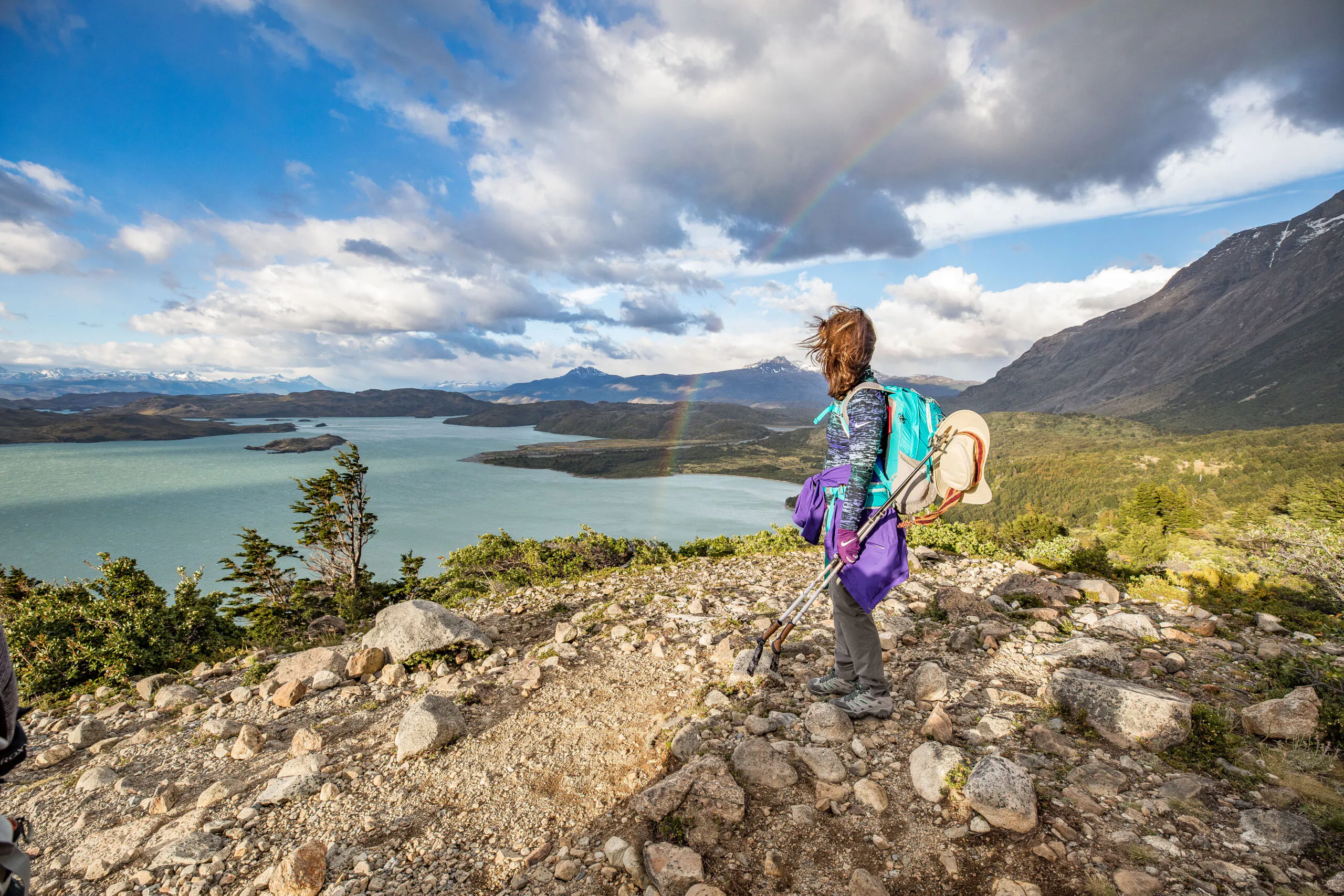
The Patagonia Lake District
Northern Patagonia’s Lake District offers a very different experience from the famous granite-and-glacier landscapes farther south. Here, the Andes are known for their deep blue lakes, snow-topped volcanoes, dense forests, and mountain towns.
On the Argentine side, the region centers around the Swiss-like adventure hub of Bariloche and Nahuel Huapi National Park. It’s an area known for its extensive network of trails and mountain refugios, making it especially popular with hikers who enjoy hut-to-hut trekking.
A particular stand-out near Bariloche is the Nahuel Huapi Traverse (or the “4 Refugios Trek”). This challenging route covers roughly 25 to 37 miles and takes between 3 to 5 days, connecting four mountain huts—Frey, Jakob, Laguna Negra, and Lopez—along the way. It also covers a diversity of terrain, including high ridges, rugged valleys, and plenty of rock scrambles, en route.
For something shorter, the region’s 7.5 to 12 mile Refugio Frey Trail takes about 3 to 5 hours each way. It leads to Laguna Toncek, a striking glacial lake surrounded by mountain scenery, and can be done as either a long day hike or an overnight refugio experience.
On the Chilean side of the Lake District, northern Patagonia becomes increasingly wild and volcanic. The multi-day Villarrica Traverse is a particularly demanding option, crossing the volcanic landscape around Villarrica National Park and passing beneath the Villarrica, Quetrupillan, and Lanin volcanoes. It runs between 46 and 50 miles, and traverses everything from temperate rainforest to ash fields and lava flows.
Northern Patagonia is also where you’ll find the Cochamo Valley, often called the “Yosemite of South America” due to its dramatic, sheer granite walls. Hiking here is an excellent choice for travelers looking to go beyond Patagonia’s best-known trails.
“[In Cochamo] We will hike beneath 3,000-foot granite walls and massive domes, tracing crystal-clear rivers and turquoise lakes. This region also shelters 11% of the world’s remaining Alerce forests—ancient giants that tower over 200 feet.”
– Andre Labarca, MT Sobek Patagonia Guide
Farther south, the Aysen Region offers a wilder, greener version of Patagonia. It’s best known for the Cerro Castillo Trek, a rugged 4 to 5 day route across alpine terrain. The trek circles the dramatic Cerro Castillo massif and its turquoise glacial lagoons, often a quieter experience than southern Patagonia’s more iconic routes.
Learn More:
Southern Patagonia: Torres del Paine
This is the region that many travelers picture when they hear the word “Patagonia.”
In Chile, the centerpiece is southern Patagonia’s Torres del Paine National Park, a spectacular landscape brimming with jagged granite peaks, glacial lakes, and enormous ice fields. It’s home to two of Patagonia’s most famous multi-day treks: the W Trek and O Circuit.
The W Trek is the classic Patagonia introduction. This roughly 47- to 50-mile point-to-point route typically takes 4 to 5 days to complete. Along the way it connects three major highlights: the Base of the Torres del Paine towers, the French Valley—with its hanging glaciers and panoramic views—and the massive Grey Glacier. Hikers also encounter bright blue lakes, ancient forests, and the enormous granite walls that define the park as they go.
The O Circuit expands this experience. At roughly 75 miles, the 7- to 9-day trek circles the Paine Massif, incorporating the W Trek while also adding the park’s wilder northern section. One of its biggest challenges is crossing John Gardner Pass, where weather and wind can change in an instant.
While the W Trek is an excellent choice for travelers who want a classic Patagonia trekking experience, the “O” draws more experienced hikers looking for a longer, more immersive adventure.
Learn More:


Southern Argentina: El Chaltén & Los Glaciares National Park
Across the border in Argentina, the small mountain town of El Chaltén serves as the country’s trekking capital, and the jumping off point for treks in Los Glaciares National Park.
El Chaltén sits beneath some of Patagonia’s most recognizable peaks, including Mount Fitz Roy. What’s more, many of the region’s most famous trails can be accessed directly from town. This makes El Chaltén especially alluring to travelers who want big mountain scenery with easy access. Day hikes are a popular option for those not wanting to spend every night in a tent or refugio.
The signature hike here is Laguna de los Tres, a challenging day-trek that’s 14 to 15.5 miles out-and-back. It pays off with a spectacular viewpoint: the spires of Mount Fitz Roy rising dramatically behind the turquoise waters of the hike’s namesake lake.
“The hiking around El Chaltén lends itself well to ambitious day hiking, unless you want to backcountry camp. Los Glaciares does not have the refugios that Torres del Paine does, so routes like the Huemul Circuit are more traditional backpacking routes.”
– Justin Woods, Head of Business Development for MT Sobek
Argentina’s 35- to 40-mile Huemul Circuit offers a whole other experience. This approximately 4-day backcountry route is considered one of the more challenging treks in the region, with strong winds, less-developed trails, and river crossings that require specialized safety equipment. The reward is an extraordinarily remote landscape with views toward the Southern Patagonian Ice Field.
Tierra del Fuego
At the southern tip of Patagonia lies Tierra del Fuego, a remote island and fjord landscape shared by Chile and Argentina.
This is Patagonia at its wildest: subantarctic forests and tundra, exposed mountain passes, and the 150-mile-long Beagle Channel running through it all.
For experienced trekkers, the Dientes de Navarino Circuit is one of this region’s ultimate challenges. Located on Navarino Island, the roughly 33-mile circuit takes 4 to 5 days and has limited trail markings, making navigation skills important. The route crosses exposed terrain beneath distinct tooth-like peaks, and offers extraordinary views toward the glacier-carved channel.
For a much more accessible introduction to the region, Laguna Esmeralda near Ushuaia, Argentina, is a shorter, 5.6 mile day-hike through forest and peat bogs to a vivid emerald-colored lagoon.

Patagonia Hiking Route Comparison Table
| Route | Region | Distance | Time | Difficulty | Where You Sleep |
|---|---|---|---|---|---|
| Laguna Esmeralda | Tierra del Fuego, Argentina | 5.6 mi round trip | Half day | Easy to moderate | Day hike from Ushuaia |
| Refugio Frey | Lake District, Argentina | 7.5–12 mi | 1 day or overnight | Moderate | Day hike or refugio |
| Laguna de los Tres | El Chaltén, Argentina | 14–15.5 mi round trip | 1 long day | Challenging | Day hike from El Chaltén |
| Cochamo Valley | Lake District, Chile | Varies | Day hikes or multi-day | Moderate to challenging | Refugio or camping |
| W Trek | Torres del Paine, Chile | 47–50 mi | 4–5 days | Moderate to challenging | Refugios or camping |
| Nahuel Huapi Traverse | Lake District, Argentina | 25–37 mi | 3–5 days | Challenging (rock scrambling) | Refugios |
| Cerro Castillo Trek | Aysen, Chile | ~32 mi | 4–5 days | Challenging | Camping |
| Villarrica Traverse | Lake District, Chile | 46–50 mi | 5–6 days | Challenging | Camping |
| O Circuit | Torres del Paine, Chile | ~75 mi | 7–9 days | Challenging (John Gardner Pass) | Refugios and camping |
| Huemul Circuit | El Chaltén, Argentina | 35–40 mi | ~4 days | Very challenging (river crossings require safety gear) | Backcountry camping |
| Dientes de Navarino Circuit | Tierra del Fuego, Chile | ~33 mi (53 km) | 4–5 days | Very challenging (limited trail markings) | Backcountry camping |
How Difficult Is Hiking in Patagonia?
One of the biggest misconceptions about Patagonia is that moderate altitude means easy hiking. The elevation may not be extreme, but the terrain and weather can be.
“It’s common for travelers to underestimate the difficulty of hiking in Patagonia. The distances and elevations can be deceiving, and once you’re out on the trails, the intense weather and rugged landscape can make it more difficult than expected. We always recommend training before any Patagonia hike. Focus your regimen on long hikes or runs, with as much elevation and ruggedness as you can access locally.”
– MT Sobek Patagonia Guide Team
Trails can include everything from sheer drop-offs and exposed terrain to loose scree and river crossings. Then there’s the wind. A route that feels manageable in calm weather can become significantly harder when you’re fighting powerful gusts or dealing with rain.
Length and steep sections can make day hikes like Laguna de los Tres considerably strenuous. With multi-day routes, you have the added challenges of carrying a backpack, hiking consecutive days, and recovering while you’re still on the trail.
Remember, you don’t need to choose the hardest route to have an extraordinary experience. Think about which hikes are most optimal for your own experience and fitness level, and then choose accordingly.
When Is the Best Time to Hike in Patagonia?
For most travelers, the best trekking season is the Patagonian summer, generally from December through February. The shoulder seasons of late spring (November) and early fall (March) are also great for their moderate temperatures and quieter visitation.
December through February offers the longest daylight hours and warmest conditions, making it the most popular time period for trekking. But this is also the peak season, which means more people, higher costs, and harder-to-secure lodgings on the most popular routes.
November and March offer great shoulder-season options. Trails are generally quieter, while March brings the added attraction of autumn color in Patagonia’s native forests. Still, nights can be considerably colder.
April through October is a whole different world. Winter brings shorter days, snow, and freezing temperatures. It also limits access to many of the major trekking routes. If you’re focused on multi-day trekking, it’s best to consider Patagonian spring, summer, and fall.
How to Plan a Patagonia Trekking Trip
Start by deciding what kind of experience you want. Would you like to hike from town each day and return to a comfortable bed? If so, El Chaltén is an excellent choice. Or maybe you’d rather spend several days immersed in the mountains? Then consider the W Trek, O Circuit, or another multi-day route.
Do you want to sleep in refugios rather than carry a full camping setup? (Hello, W Trek!). Or are you an experienced backpacker looking for something more remote? A route such as the Huemul Circuit would be perfect.
What to Pack
The golden rule is simple: pack for changing weather.
A good layering system is essential. Bring moisture-wicking base layers, an insulating layer like a lightweight down jacket, and a waterproof, windproof shell. Rain pants are also must-haves when conditions deteriorate.
Your footwear also matters. Choose sturdy, broken-in hiking boots with good traction and make sure you’ve tested them before your trip. Loose rock, uneven terrain, and wet conditions are all possibilities.
Trekking poles are extremely useful on steep climbs and descents and can provide additional stability when strong winds hit. And don’t forget the small things: sun protection, sunglasses, a hat, gloves, and a buff or neck gaiter are all equally important.
Getting to Patagonia
Most southern Patagonia trekking trips start with a flight to one of two gateways: Punta Arenas in Chile, for Torres del Paine, or El Calafate in Argentina, for El Chaltén and Los Glaciares National Park. Plenty of travelers visit both, linking them overland.
Getting to Torres del Paine, Chile
Punta Arenas has daily nonstop flights from Santiago, Chile. From Punta Arenas, it’s about a three-hour bus ride or drive north to Puerto Natales, the small waterfront town that serves as the base for Torres del Paine. During the summer trekking season (November to March), seasonal flights from Santiago also land in Puerto Natales, saving you the drive. The park is roughly two hours from town, and buses run to the main trailheads at Laguna Amarga and Pudeto, where a catamaran crosses Lake Pehoe to the W Trek’s western end.
Getting to El Chaltén, Argentina
El Calafate has regular flights from Buenos Aires, plus connections from Bariloche and Ushuaia. It’s also the jumping-off point for the Perito Moreno Glacier, an easy add-on before or after your trek. El Chaltén and the trailheads of Los Glaciares National Park are about three hours north by bus or car from El Calafate.
Combining Chile and Argentina
El Calafate and Puerto Natales are about five hours apart by bus, including the border crossing. Keep your passport handy, and don’t carry fresh fruit, meat, or dairy into Chile or vice versa; agricultural inspections at the border are strict. If you’d rather not juggle buses, border crossings, and transfers yourself, a guided trip like MT Sobek’s Ultimate Patagonia Hiking Tour handles the logistics between both countries.
Torres del Paine Permits & Reservations
Torres del Paine is one place in Patagonia where you can’t just show up and start hiking. Here’s what to know:
- Buy your park ticket in advance. Entry tickets are sold online through CONAF, Chile’s national park service, at pasesparques.cl. Don’t count on buying one at the gate. Multi-day treks require a multi-day pass.
- Every night must be booked. Overnight stays on the W Trek and O Circuit are allowed only at designated refugios and campsites, and each night must be reserved ahead of time. Primitive camping isn’t permitted, and rangers check reservations along the trail.
- You’ll likely book with two companies, as accommodations are run by two private operators. Las Torres Patagonia manages sites such as Central, Chileno, Cuernos, Frances, and Seron. Vertice Patagonia runs Paine Grande, Grey, Dickson, and Los Perros. Map out your itinerary night by night so both sets of bookings line up.
- Book as early as possible. Reservations for the October-to-April season typically open in the preceding autumn months (April through June), and December through February dates can sell out quickly. Aim to start planning at least five to six months ahead.
Argentina is more relaxed. Day hikes from El Chaltén, including Laguna de los Tres, generally don’t require advance bookings or permits, though it’s worth checking current park rules before you go. Remote routes like the Huemul Circuit may require registering with park rangers before setting out.


Patagonia Trail Etiquette
Patagonia’s wilderness is part of what makes it special, so protecting it is everyone’s responsibility.
Stay on established trails, follow park regulations, and pack out your trash. Water is generally plentiful along many trekking routes, particularly around glacial streams and mountain areas. Still, water treatment or filtration is a smart precaution, especially when you’re traveling independently. Finally, don’t underestimate the weather. Check conditions before setting out and be prepared to adjust your plans if conditions prove unsafe. A flexible itinerary is key when trekking in Patagonia’s seemingly endless wilds.
Start Planning
The best thing about hiking in Patagonia is that you don’t have to be a hardcore backpacker to experience it. Consider the amount of time you have, how challenging of a trek you’d like, whether you’d prefer to hike independently or with a guide, and your preference for bedding down in tents and refugios or snoozing in comfy lodgings.
Then choose the hike that fits you best.

Enjoying our content? Add MT Sobek as a Google Preferred Source.
FAQs
There isn’t one answer. Torres del Paine is the classic choice for multi-day trekking, while El Chaltén is exceptional for day hiking beneath Fitz Roy. Northern Patagonia offers quieter alternatives such as Cochamo. On the other hand, Tierra del Fuego provides a more remote, subantarctic experience.
You can experience Patagonia with just a few days of hiking, but a week or longer allows you to be more flexible. The W Trek is a 4 to 5 day excursion, while the O Circuit takes roughly 7 to 9 days. By basing yourself in El Chaltén, you can easily combine multiple day hikes over several days.
Yes, provided you choose the right itinerary. Patagonia has accessible day hikes as well as challenging multi-day routes. First-time trekkers might consider a guided itinerary or a route with established lodgings rather than starting with a remote backcountry circuit.
Not necessarily. Some of Patagonia’s most popular trails are accessible to independent hikers, while more remote routes require stronger navigation and wilderness skills. Patagonia adventure travel outfitters like MT Sobek can also simplify transportation, logistics, meals, accommodations, and changing plans when weather gets in the way.
The O Circuit is generally more demanding because it’s longer, includes wild and remote terrain, and requires crossing the challenging John Gardner Pass. The W Trek is shorter and more accessible, making it a popular introduction to multi-day trekking in Patagonia.
Absolutely. Some of the region’s best hiking destinations are ideal for day hiking from a comfortable base. Or you can book a guided trip like MT Sobek’s Ultimate Patagonia Hiking Tour, which combines Chile’s W Trek with hiking in Argentina’s Los Glaciares National Park. The itinerary incorporates centrally located hotels and small wilderness lodges, allowing travelers to access spectacular trails without camping.
For the best combination of trail access, daylight, and warmer conditions, consider November through March. While December through February is peak season, November and March offer a quieter experience and seasonal changes, such as wildflowers in spring (November) and fall foliage (March-April).
Ask an Expert
We want you to have the best adventure, so don’t hesitate to call our expert team of adventure specialists at 800-974-0300 to learn more. Or click the button to use our online contact form.
Learn More About Adventure Travel in Patagonia


